

Graduation season should be about launching your career, not dodging scams.
But for many new grads, the job search now comes with a hidden risk: fake recruiters, fraudulent job offers, and convincing messages designed to steal money, personal information, or both.
The threat is larger than many people realize. According to McAfee’s 2026 State of the Scamiverse report, 76% of Americans have encountered a scam, and the average person receives 14 scam messages every day through text, email, and social media. Americans now spend an estimated 114 hours each year trying to figure out what is real online and what is not.
Young adults are among the most heavily targeted groups. Nearly 3 in 10 people ages 18 to 24 (28%) report receiving conversational scams that begin with casual outreach such as “Hey, how are you?” or a “wrong number” text. Those same tactics increasingly appear in fake recruiter messages, LinkedIn outreach, and texts promoting remote job opportunities.
Today’s job scams can look highly professional. Scammers build polished LinkedIn profiles, clone legitimate company websites, and even use AI-generated interviews to appear credible. Many scams unfold quickly, with nearly half completed in less than an hour, creating pressure to act before candidates have time to verify what is real.
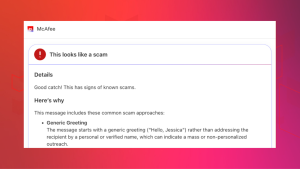
That’s where tools like McAfee’s Scam Detector come in—flagging suspicious emails, texts, links, and messages before you engage, so you can tell what’s real before you click.
Here’s how to avoid job scams and stay safe with McAfee:

How Job Scams Actually Work
|
Step |
What Happens |
Red Flags |
What Scammers Want |
|
1. The Outreach |
You’re contacted via email, text, or social media about a job |
Unsolicited offer, vague role, overly enthusiastic recruiter |
Your attention |
|
2. The Build-Up |
They walk you through interviews or onboarding steps |
No video calls, inconsistent details, fast timeline |
Your trust |
|
3. The Ask |
They request personal info or payment |
SSN requests, bank info, “training fees” |
Identity + money |
|
4. The Trap |
They escalate the situation or disappear |
More payment requests or sudden silence |
Continued financial gain |
A Real Example: How People Get Pulled In
Even experienced professionals fall for these scams.
In one case, a tech expert with decades of experience lost $13,000 after accepting what looked like a legitimate part-time role reviewing products.
The opportunity seemed real:
- A polished website
- Structured onboarding
- A small initial payout
Then came the shift. He was told he needed to deposit money to continue working and kept paying more to “unlock” earnings that never came.
This type of advance fee scam is increasingly common in job fraud, and it works because it builds trust first.
What the Data Says
Recent graduates are entering the workforce at a time when scams are more sophisticated, more personalized, and harder to spot than ever before. McAfee’s 2026 State of the Scamiverse report highlights why younger job seekers should be especially cautious.
Young Adults Face Higher Risk
- Younger adults report the highest rates of repeat scam victimization. McAfee’s research found that scam victims under 35 are more likely than older adults to be targeted again, suggesting that early-career professionals may be especially vulnerable as they navigate job searches, salaries, and onboarding for the first time.
Scam Messages Are Constant
- Americans receive 14 scam messages per day on average.
- 76% of Americans say they have encountered an online scam.
- People spend 114 hours per year, nearly three full workweeks, trying to determine what is real and what is fake online.
Professional Platforms Are Not Immune
- 7% of respondents reported encountering scams on LinkedIn.
- 44% have replied to suspicious messages that contained no link at all.
Many modern scams begin with a simple message such as “I came across your profile” or “We’d like to discuss an opportunity,” rather than an obviously suspicious URL.
Job Scams Move Fast
- The average scam unfolds in just 38 minutes.
Scammers often create urgency by claiming a role is limited, an offer will expire quickly, or onboarding must begin immediately.
AI Makes Fake Recruiters More Convincing
- 35% of Americans are not confident they can spot deepfake scams.
- McAfee predicts job scams will become increasingly personalized as scammers use AI to create tailored outreach, onboarding documents, and contracts that closely match a candidate’s background.
Job Scams Are a Growing Financial Threat
- FTC-reported job scam losses rose nearly 40% year over year, increasing from $543 million in 2024 to $752 million in 2025.
For new graduates eager to land their first job, the lesson is simple: if an opportunity seems rushed, asks for money, or feels too good to be true, take a step back and verify before you respond.
Where McAfee Comes In
Job scams don’t just happen in one moment. They unfold in stages—first a message, then a conversation, then a request for information or money.
That’s why protection needs to work the same way: across the entire experience. McAfee’s comprehensive protection helps you stay ahead of job scams at every step:
McAfee+ Advanced gives you multiple layers working together so you are not left figuring it out after the damage is done:
- Identity Monitoring alerts you if your personal info shows up where it should not, so you can act fast
- Personal Data Cleanup helps remove your information from data broker sites, making you harder to target in the first place
- Scam Detector flags suspicious texts, emails, links, and even deepfake videos before you engage
- Safe Browsing helps block risky sites if you do click
- Device Security helps detect malicious apps or downloads
- Secure VPN keeps your data private, especially on public Wi-Fi
The Biggest Red Flags to Watch For
These patterns show up again and again in job scams:
|
Red Flag |
What It Looks Like |
Why It’s a Problem |
What to Do Instead |
|
Requests for Sensitive Information Too Early |
Asked for your Social Security number, banking info, or ID details early in the process |
Scammers use this to steal your identity or access your accounts |
Only share sensitive info after accepting a verified job—and through secure onboarding systems |
|
You’re Asked to Pay to Work |
Fees for training, equipment, onboarding, or background checks |
Legitimate employers don’t charge candidates to get hired |
Walk away immediately—this is one of the clearest signs of a scam |
|
The Job Sounds Too Good to Be True |
High pay, low hours, minimal experience required, vague responsibilities |
Designed to hook attention and lower your guard |
Research typical salaries and ask detailed questions about the role |
|
The Hiring Process Moves Too Fast |
Immediate job offers or rushed decisions without interviews |
Real hiring processes involve multiple steps and evaluations |
Be cautious of offers that skip standard hiring steps |
|
No Real Interaction |
Communication only via email or chat, refusal to do video or phone calls |
Scammers avoid real-time interaction to stay anonymous |
Request a video call or verify the recruiter through official company channels |
How to Protect Yourself
You don’t need to overcomplicate it. Stick to a few grounded habits:
- Verify the company independently: Search the company, check official sites, confirm recruiter identities
- Keep communication on trusted platforms: Be cautious with offers coming from unexpected channels
- Never pay upfront for a job: That’s a dealbreaker
- Pause before sharing personal information: Especially early in the process
- Use tools that flag risks automatically: Scam Detector helps catch what looks legitimate, but isn’t
What to Do If You Think It’s a Scam
If something feels off:
- Stop communication immediately
- Do not send money or personal information
- Report the scam to the FTC
- Monitor your accounts for suspicious activity
If you’ve already shared sensitive information, act quickly to secure your accounts.
With McAfee’s comprehensive protection, you’re not left to figure it out on your own.
From blocking risky links to monitoring your identity and helping you respond quickly, it’s designed to help you stay one step ahead, and recover faster if needed. Because job searching is stressful enough without scammers, and you deserve to land your next job with confidence.
Stay Updated
Follow us to stay updated on all things McAfee and on top of the latest consumer and mobile security threats.