

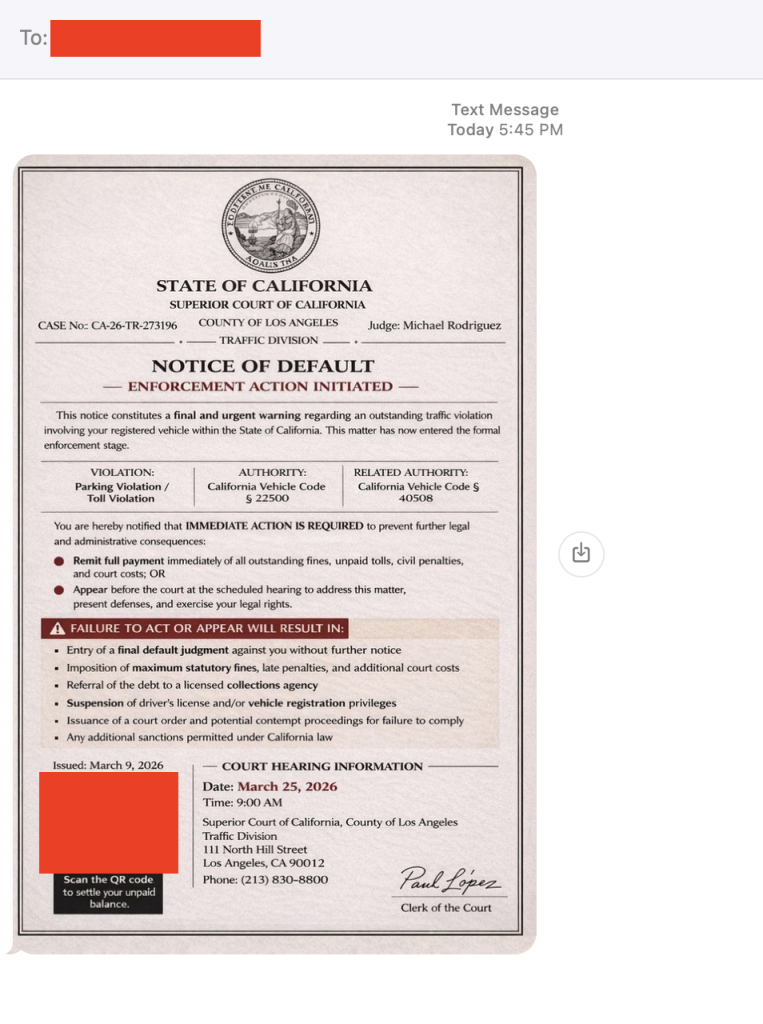
A text that looks like it came straight from a courthouse is making the rounds across the U.S. And yes, I got it too.
First things first, that’s a scam. And to be clear: DON’T SCAN THAT QR CODE.
It’s the same playbook as last year’s toll road scams, just dressed up with a little more authority and a lot more pressure.
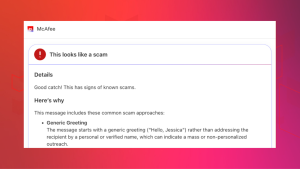
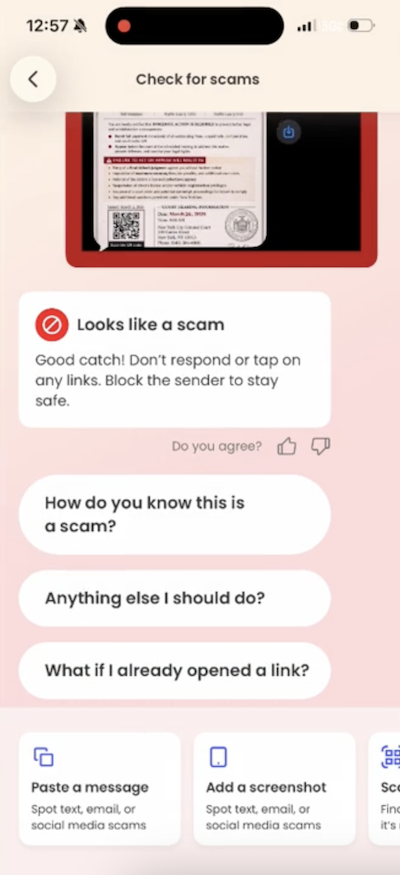
Before doing anything, our team ran it through McAfee’s Scam Detector. It immediately flagged the message as suspicious, and that’s exactly the kind of moment this tool is built for. When something feels just real enough to second guess, it gives you a clear signal before you click, scan, or spiral.
This court notice scam has ramped up and changed shape since we first covered it in March. So let’s get into how it works:

How the scam works
The text claims you’ve missed a payment, violated a law, or have some kind of outstanding “case.” It then pushes you to scan a QR code or click a link to resolve it quickly.
From there, one of two things usually happens:
- You’re taken to a fake payment page designed to steal your money, or
- You’re prompted to download something that gives scammers access to your device or data
Either way, the goal is the same: get you to act fast before you have time to question it.
The red flags in this message
- Urgent, threatening language about fines, penalties, or legal action
- Vague accusations with no real details about what you supposedly did
- Official-looking formatting like case numbers, clerk signatures, and judge names
- Copy-paste consistency across states: McAfee employees in New York and California received nearly identical messages with the same names
There are reports of this scam popping up nationwide, but the rule is simple: law enforcement does not text you to demand payment or resolve legal issues.
What to do if you scanned the QR code
First, don’t panic. Then:
- Do not pay anything or enter personal information
- Do not delete apps you were told to install (this can make it harder to detect what happened)
- Run a device scan using a trusted security tool like McAfee’s free antivirus
- Keep an eye on your financial accounts and logins for unusual activity
And that, my friends, is scam number one in this week’s This Week in Scams (new format, we’re experimenting a little).
Let’s get into what else is on our radar.
Deepfake Celebrity Ads Are Targeting Seniors on Social Media. Here’s What a New Study Found.
If you saw our story last year about Al Roker speaking out after scammers used an AI-generated version of him to promote a fake hypertension cure, or the shocking case of a French woman who lost nearly $900,000 to fraudsters posing as Brad Pitt, you already know just how convincing celebrity deepfake scams have become.
Now, new reporting suggests these scams are reaching older adults at enormous scale.
According to a new study from the Center for Countering Digital Hate, just 30 of the most active scam advertisers on Facebook generated an estimated 215 million ad impressions over the past year. Nearly 73% of those impressions were shown to adults over 65.
The fake ads used AI-generated versions of well-known figures including Donald Trump, Joe Biden, Oprah Winfrey, Steve Harvey, and Brad Pitt to promote fake government benefits, miracle health products, and bogus financial offers.

What McAfee’s Data Says About Celebrity Deepfake Scams
This aligns closely with McAfee’s 2025 Most Dangerous Celebrity: Deepfake Deception List.
Our research found that:
- 72% of Americans have seen a fake celebrity or influencer endorsement online
- 39% have clicked on one of these ads or posts
- 1 in 10 lost money or personal information
- Average losses reached $525 per victim
The celebrities most commonly exploited in the U.S. included Taylor Swift, Scarlett Johansson, Jenna Ortega, and Sydney Sweeney, while Brad Pitt also ranked prominently on the global list.
Why These Scams Work So Well
Celebrity deepfake scams exploit something simple: trust.
When a familiar face appears in your social feed, whether it is Al Roker recommending a health product or Brad Pitt asking for help, your guard naturally drops.
And AI is making these fakes harder to detect.
McAfee’s 2026 State of the Scamiverse found that Americans now encounter an average of three deepfakes every day, yet more than one in three say they are not confident they can identify one.
In other words, scammers are weaponizing the faces people know best to make fraud feel familiar.
How to Spot a Deepfake on Social Media
Celebrity deepfakes are designed to look convincing, but there are still clues that something is off. If you see a video of Oprah Winfrey, Al Roker, or Brad Pitt promoting a miracle cure, government benefit, or investment opportunity, pause before you click.
Here are some of the biggest red flags to watch for:
| Red Flag | What to Look For |
| Too-good-to-be-true offers | The video promises free grocery money, secret Medicare benefits, guaranteed investment returns, or miracle health cures. |
| Out-of-character endorsements | A celebrity appears to promote a random supplement, financial opportunity, or government program that seems unrelated to their normal work. |
| Robotic or unnatural voice | The speech sounds overly smooth, lacks natural pauses, or has strange pacing and tone. |
| Lip-sync issues | The celebrity’s mouth movements do not perfectly match the words being spoken. |
| Unnatural facial expressions | Blinking, smiling, and head movements appear stiff, overly polished, or slightly off. |
| Urgent language | The ad pressures you to “Act now,” “Claim your benefits today,” or “Limited spots available.” |
| Suspicious links | Clicking leads to a website you do not recognize or that does not match the company or organization being referenced. |
| No confirmation elsewhere | Trusted news outlets and the celebrity’s verified accounts do not mention the same announcement or offer. |
When in doubt, go directly to the celebrity’s verified social account or search trusted news sources to confirm the information. And if something feels off, trust your instincts. In the age of AI, seeing is no longer believing.
How McAfee Helps You Stay Ahead of These Scams
McAfee+ Advanced gives you multiple layers working together so you’re not left figuring it out in the moment:
- Scam Detector flags suspicious texts, emails, links, and even deepfake videos before you engage
- Safe Browsing helps block risky sites if you do click or scan
- Device Security helps detect and remove malicious apps or downloads
- Identity Monitoring alerts you if your personal info shows up where it shouldn’t, so you can act fast
- Personal Data Cleanup helps remove your information from data broker sites, making you a harder target in the first place
- Secure VPN keeps your data private, especially on public Wi-Fi
Safety tips to carry into next week
- Slow down when a message creates urgency. That’s the hook
- Don’t scan QR codes or click links from unexpected texts
- Go directly to official websites instead of using links sent to you
- Use tools that flag scams in real time so you don’t have to guess
- Don’t trust celebrity endorsements posted to social media unless they come directly from a celebrity’s official page
The reality is, these scams are designed to look normal. You shouldn’t have to be an expert to spot them. That’s why McAfee’s here to help.
We’ll be back next week with more scams making headlines.
Stay Updated
Follow us to stay updated on all things McAfee and on top of the latest consumer and mobile security threats.