

There is a small tax many of us pay in our everyday interactions without even realizing it.
A package notification arrives, and we stop to check whether we actually ordered something. A recruiter reaches out about a job, but before replying, we research the person and the company. A bank alert appears, and instead of tapping the link, we open the banking app ourselves.
These are sensible habits. But McAfee’s latest research suggests the effort behind them is increasing the average American’s every day mental load.
Nearly three-quarters of Americans (74%) say they feel the need to double-check most things online before trusting them. Sixty-two percent say figuring out what is real takes more mental energy than it did a year ago.
That growing burden is one reason McAfee is introducing a new brand and product experience built around a broader idea of what protection should do. Good security shouldn’t demand more of people’s attention. It should help give some of it back.

That’s why the new McAfee experience is designed to do more than protect individual devices. It helps protect the things people rely on every day, their personal information, connections, devices, and accounts, all while making it clearer what’s safe, what needs attention, and what McAfee can handle for them.
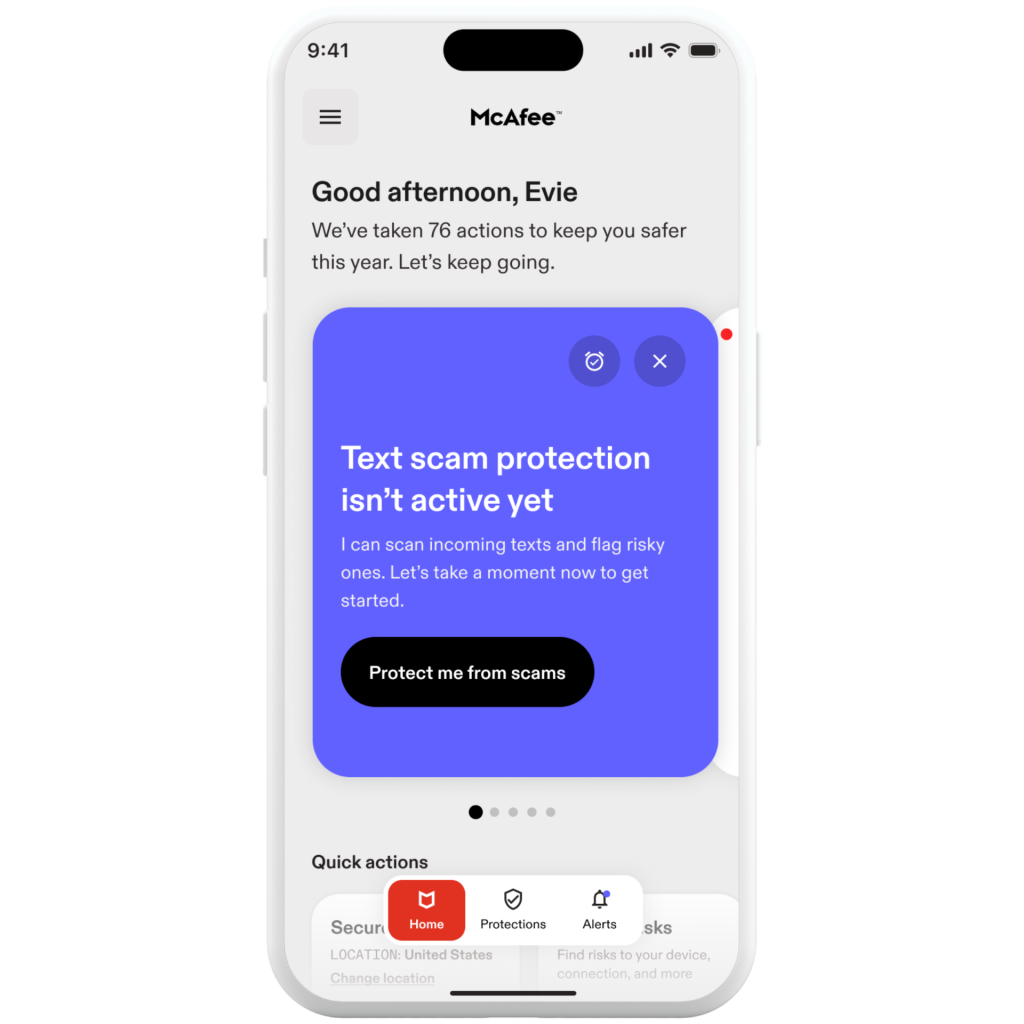
Get quick alerts and easily update protections in McAfee’s app
That matters at a moment when attention is already stretched thin. AI is everywhere, and it has made it easier to produce convincing content at an enormous scale, adding to an already crowded attention economy. Increasingly, ordinary moments come with an extra question: Is this real?
And those questions have consequences. Our research found that 82% of Americans have changed how they behave online because of scams. Some have stopped buying from unfamiliar retailers. Others have ignored communications that turned out to be legitimate. Eighteen percent say scam concerns have even caused them to avoid responding to a job opportunity.
“I’ve accused my doctor’s office of being an AI,” says McAfee Threat Researcher Charles McFarland, recounting a time when even he thought something legitimate was fraudulent. “I had to apologize.”
Financial losses remain a serious part of the picture. Nearly one-third of Americans (31%) reported losing money to a scam in the past year. But measuring scams only in dollars misses something important. Scams are also making trust more expensive.
This report examines that growing cost: the attention Americans are spending figuring out what to trust, how the scam experience differs across all 50 states, and what protection should look like when staying safe increasingly competes for the same limited time and attention as everything else we do online.
Key Findings
McAfee’s research combines a nationally representative survey of 5,000 U.S. adults, with 100 respondents in every state, and McAfee Labs analysis of text-based scam activity across the U.S.
Together, the findings show how scams are affecting not only Americans’ wallets, but also their attention, trust and behavior online.
Scams are placing a growing burden on Americans’ attention. Nearly three-quarters (74%) say they feel the need to double-check most things online before trusting them, while 62% say figuring out what is real takes more mental energy than it did a year ago. (Survey)
That uncertainty is changing legitimate online behavior. Eighty-two percent say scam concerns have changed something they do online. Forty-four percent have avoided buying from an unfamiliar retailer, 37% have ignored a legitimate call, text or email, 34% have avoided a new app, website or service, 33% have avoided a legitimate link and 25% have abandoned an online purchase. (Survey)
Scams can make real opportunities harder to trust. Twenty-seven percent encountered a fake recruiter or job opportunity in the past year. At the same time, 18% say scam concerns have caused them to avoid responding to a job opportunity. (Survey)
Financial losses are widespread, and getting money back can be difficult. Nearly one-third of Americans (31%) report losing money to a scam in the past year. Among those who lost money, 53% recovered none. In Wyoming, Kansas, Louisiana, California and New Mexico, more than 70% of victims who lost money recovered nothing. (Survey)
Investment and cryptocurrency scams dominate text-based scam activity. McAfee Labs found them to be the leading scam-text category by volume in 47 of 50 states from May through July 2026. Maine, North Dakota and Michigan were the exceptions. In Maine and North Dakota, toll and traffic scams ranked first. Meanwhile, in North Dakota, loan and investment scams ranked first. (McAfee Labs)
The volume and intensity of scam texts varies considerably by state. Alabama averaged 5.14 scam texts per device, the highest in McAfee’s analysis. In North Dakota, scams represented 2.8% of analyzed text traffic, the highest concentration nationally. In Hawaii, devices receiving at least one scam text averaged 8.45 scam messages during the three-month analysis period. (McAfee Labs)
Some states experience especially high exposure or financial consequences. Ninety-five percent of Nevada respondents encountered at least one type of scam in the past year. In Ohio, 41% reported losing money to a scam. Thirty percent of New Jersey respondents say they encounter four or more scam attempts on a typical day. North Carolina stood out in the other direction: 42% of victims who lost money said they recovered all of it. (Survey)
Many scam texts are designed to begin a conversation rather than complete the scam immediately. Joining or clicking through to a WhatsApp group was the most common requested action in the scam texts McAfee analyzed, driven largely by investment and cryptocurrency schemes. The initial message may be only the first step in a longer attempt to build trust before asking for money. (McAfee Labs)

Displays the number of scams seen per unique device
The New Scam Landscape
Scams no longer occupy some separate, obviously suspicious corner of the internet. Increasingly, they imitate the ordinary business of being online.
In its analysis of U.S. text-based scams from May through July 2026, McAfee Labs identified 49 leading scam topics across 23 broader categories. They touched nearly every part of daily life: package deliveries and bank accounts, job offers and investments, shopping and subscriptions, health and utilities, relationships and family emergencies.
 Example of one of the many types of delivery text scams consumers face
The full list spans Cloud Storage & Payment; Package & Delivery; Banking & Financial; Toll & Traffic Violation; Tax & IRS; Legal Threat & Law Enforcement; Government Impersonation; Tech Support & Security; Prize & Lottery; Romance & Relationship; Employment & Job Offer; Subscription & Service; Account Verification & Account Alerts; Investment & Cryptocurrency; Charity & Donation; Utility & Bill Payment; Health & Pharmacy; Family & Friend Emergency; Retail & Shopping; Loan & Debt Relief; Buying Property & Real Estate; Context-Free Links & Phone Numbers; and Other.
That breadth matters. The more scams resemble the normal messages people receive every day, the more ordinary life requires verification.
One category nevertheless dominated. Investment and cryptocurrency scams were the largest text-scam category by volume in 47 of 50 states. Only Maine, North Dakota and Michigan broke the pattern, with toll and traffic violation scams as well as loan and investments ranking first.
The prevalence of investment scams is important because many are not trying to steal money with a single text. They are trying to start a relationship.
The most common action requested in the scam texts analyzed by McAfee was clicking or joining a WhatsApp group, driven heavily by investment and cryptocurrency schemes. A message might promote an investing community or offer access to financial advice.
 Example of a scam text attempting to move users to WhatsApp
Moving the recipient into a group or private conversation gives the scammer more time to establish credibility before money enters the picture. Plus, for many of us, social apps feel more personal and we more easily let our guard down when we move a conversation to these messaging platforms.
That helps explain why an unsolicited text that looks relatively harmless can still be the beginning of a much longer scam.
Other prominent scams rely on a different tactic: urgency. Fake account alerts can suggest that something needs immediate attention. Toll and traffic scams warn of an unpaid charge or violation. McAfee Labs also saw scammers impersonating T-Mobile with fake reward offers among the largest individual scam topics.
 Example of scammers exploiting trusted brands like T-Mobile to dupe customers
The stories change, but the underlying objective is often the same. Scammers want people to act before they have time to question what they are seeing. And there is a lot to question.
Across the United States
McAfee’s analysis found meaningful differences in the amount of scam traffic reaching consumers around the country during the three month analysis period. Alabama recorded an average of 5.14 scam texts per device, the highest in the analysis. Georgia followed at 4.67, with Mississippi close behind at 4.64.
North Dakota stood out in a different way. There, scams represented 2.8% of all text traffic McAfee analyzed, the highest concentration in the country. Hawaii showed another pattern: among devices that received at least one scam text, the average was 8.45 scam messages during the three-month period. That was about 15% higher than Alabama, which ranked second at 7.35 scam texts per exposed device.
| Rank | State | Scams per device | State | Scams per device scammed |
| 1 | Alabama | 5.14 | Hawaii | 8.45 |
| 2 | Georgia | 4.67 | Alabama | 7.35 |
| 3 | Mississippi | 4.64 | Ohio | 7.29 |
| 4 | Nevada | 4.54 | Florida | 7.29 |
| 5 | Tennessee | 4.50 | North Dakota | 7.28 |
A third measure shows how concentrated scam traffic was within people’s overall text messages. North Dakota had the highest concentration in the country, with scams accounting for 2.8% of all text traffic McAfee analyzed.
These measures capture different dimensions of the same problem. The all-device average shows how many scam texts reached devices across a state overall. The exposed-device average shows how persistent scam activity was for devices that received at least one scam. And the share of total text traffic shows how prominent scam messages were within the broader messaging environment.

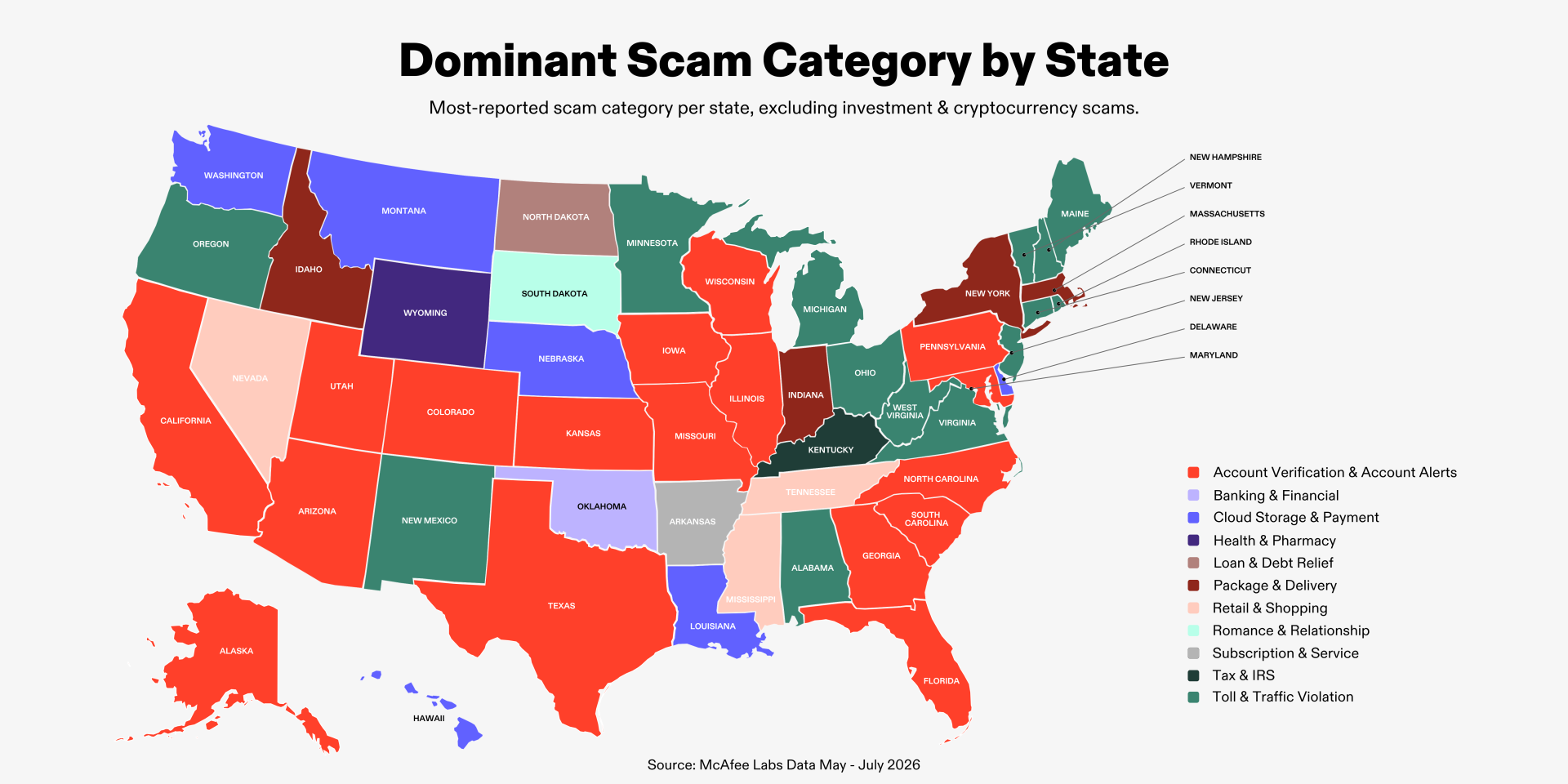
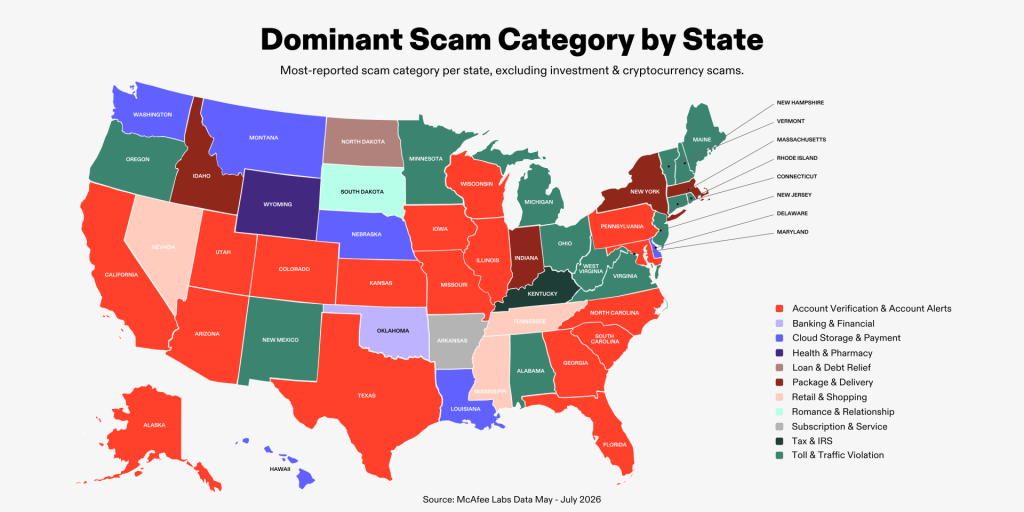
This shows each states top scam category by volume if Investments & Cryptocurrency scams are ignored. Notice these colors don’t necessarily match the colors from the previous graph.
For consumers, those distinctions may be invisible. What they experience is repetition: another message asking for attention and another decision about whether it deserves it.
AI raises the stakes further. It can make convincing scam content cheaper and faster to produce, while people are simultaneously encountering more AI-generated material in everyday online life. The result is an environment where the old advice to simply “look for something suspicious” becomes harder to apply reliably. Sometimes the suspicious thing looks perfectly ordinary.
That is why the next phase of consumer protection cannot depend on people becoming infinitely better at scrutinizing everything themselves.
America’s Scam Reality
McAfee’s consumer research shows what happens when that scam environment meets everyday life.
Most Americans are encountering scams regularly. Eighty-eight percent say they experienced at least one type of scam in the past year, and one in five say they typically encounter four or more scam attempts in a single day.
Yet frequency tells only part of the story. The more consequential finding may be what people are doing in response.
Eighty-two percent say scam concerns have changed their online behavior. Forty-four percent have avoided an unfamiliar retailer. Thirty-seven percent have ignored a legitimate call, text or email because they suspected a scam. Thirty-three percent have avoided clicking a legitimate message or link.
These are not examples of people falling for scams. They are examples of people trying not to.
Job scams make that tradeoff particularly tangible. Twenty-seven percent of Americans say they encountered a fake recruiter or job opportunity in the past year. Eighteen percent say concerns about scams have caused them to avoid responding to a job opportunity.
The financial consequences remain substantial when a scam does succeed. Nearly one-third of Americans (31%) report losing money to a scam in the past year. Among those victims, 53% recovered none of what they lost.

From our McAfee Labs Research: This shows approximate location of all the scams received
But a national average can obscure how differently people experience the problem.
Our full 50-state scam breakdown examines the data state by state, combining McAfee’s consumer survey with Labs telemetry to show where scam exposure is highest, where financial recovery is hardest, how concerns affect behavior, and which types of text scams McAfee is seeing across the country.
Across those differences, one finding remains remarkably consistent: Americans are adapting. They are checking more carefully and approaching unfamiliar interactions with greater caution, or even avoiding them altogether.
Those behaviors can help keep people safe. But that puts the mental load on back onto the everyday user. There is a limit to how much vigilance we should expect people to supply on their own.
The better question is how technology can take on more of that work for them. And that is the thinking behind McAfee’s new brand and product experience, beginning its rollout in the U.S. today.
How McAfee is Changing to Meet the Moment
McAfee’s new consumer experience is designed to make protection simpler to understand and easier to act on, while helping people navigate the moments where scams and other threats increasingly create uncertainty.
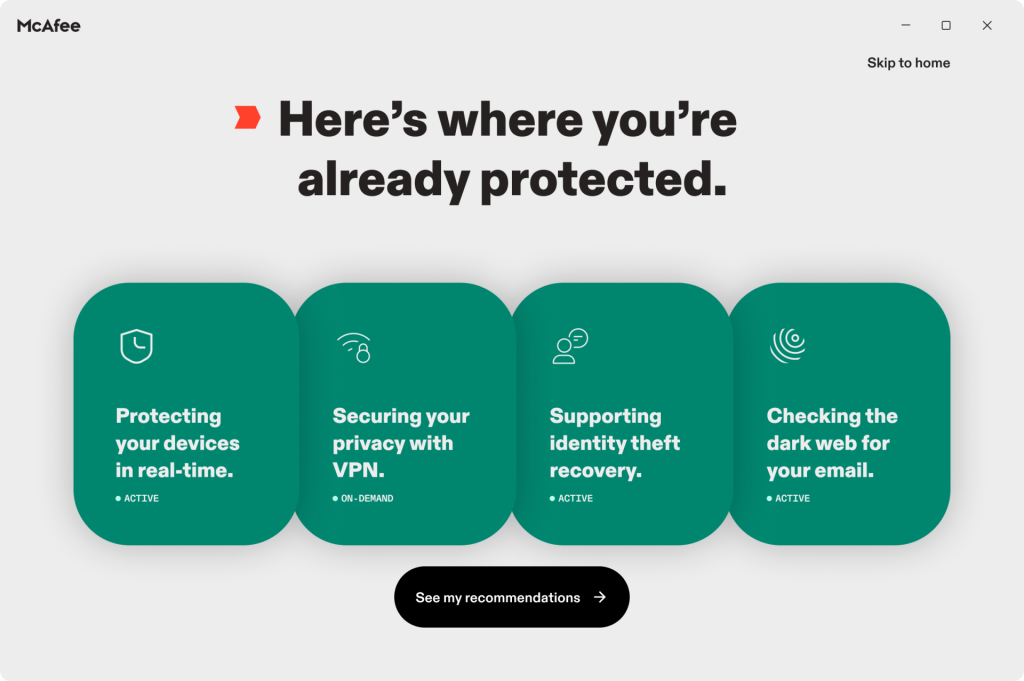
We’ll let you know if something seems suspicious and could put you at risk.
The experience is built to spot risks earlier, guide people clearly, and act when protection can be handled automatically. That means flagging suspicious messages, links, sites, exposed data, or unsafe connections; explaining what matters in plain language; and helping people take the right next step without requiring them to become security experts.
McAfee can alert you when your information appears in a data breach, help identify suspicious messages and links, protect your connection on risky Wi-Fi, monitor for exposed personal information, and help keep your devices and accounts safer.
Just as importantly, we’ve worked to make those protections understandable.
Instead of expecting people to know cybersecurity terminology or hunt through settings, the experience is designed to surface what matters and help people understand what to do next.
Because good protection shouldn’t create another job for you.
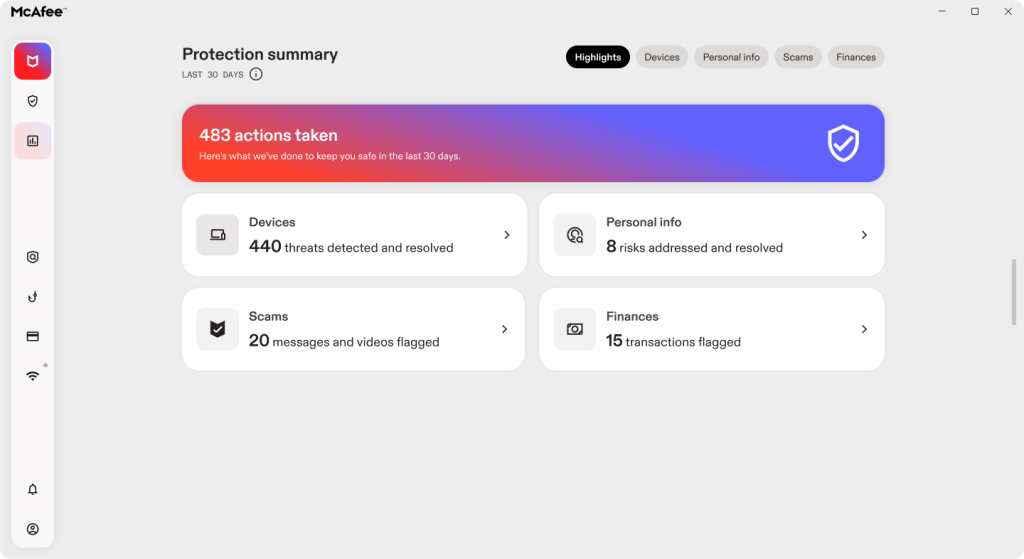
The refreshed McAfee experience makes it easier to see what needs your attention and how you’re protected.
What We’re Unveiling
That idea, making protection do more of the work, is built into the new McAfee experience we’re unveiling today.
We’ve brought protection for personal information, connections, and devices into one connected experience across PC, Mac, mobile, and tablet. Instead of asking people to piece together what’s protected or search for what needs attention, McAfee makes it easier to see both in one place.
The experience is also more personal. McAfee can alert you when your information or devices may be at risk and provide guided actions, that explain what needs your attention in plain language. The goal is not to give people more security information. It’s to help them understand what matters to them and what they can do about it.
And over time, the experience is designed to become more personal and relevant to each person, proactively identifying risks, alerting in the moment, and guiding when action is needed for the protections that matter most based on their digital life.
We’ve also made improvements to privacy tools like Online Account Cleanup, which now helps people prioritize higher-risk accounts, and Personal Data Cleanup, which makes it easier to see the personal information being found and removed on their behalf.
Taken together, these changes reflect where we believe consumer safety needs to go: less hunting through settings, less deciphering security alerts, and less relying on people to spot every threat themselves.
More protection that understands what matters, explains what needs attention, and works proactively in the background.
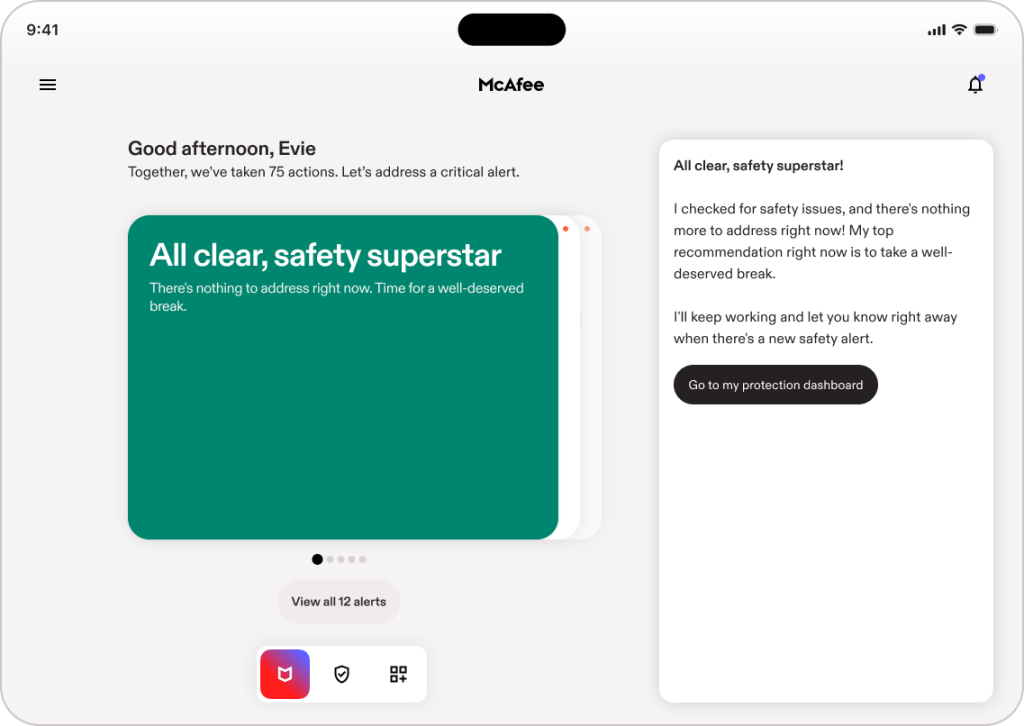
Here to give you peace of mind and lighten the mental load of life online.
Conclusion
The findings in this report suggest that the impact of scams extends beyond exposure and financial loss.
Every scam adds another small decision to an already crowded digital day: Is this message real? Is this link safe? Is this person who they say they are? As those decisions multiply, staying safe online becomes not just a security challenge, but a growing mental burden.
As people encounter more attempts to imitate legitimate messages, businesses and opportunities, the effort required to establish trust becomes a consequence in its own right.
That makes reducing the burden of verification an increasingly important part of consumer protection. People should not have to devote more of their limited attention to staying safe simply because scams are becoming harder to distinguish from everyday life online. That’s where McAfee comes in.
Stay Updated
Follow us to stay updated on all things McAfee and on top of the latest consumer and mobile security threats.