

Social media platforms connect you to thousands of people worldwide. But while these platforms offer incredible opportunities for bonding, learning, and entertainment, they also present personal security challenges. Navigating them safely requires being aware of risks and proactively protecting your accounts.
The three most common risks you’ll encounter are privacy exposure, account takeover, and scams. Privacy exposure occurs when your personal information becomes visible to unintended audiences, potentially leading to identity theft, stalking, or professional damage. You have control over your social media security. By implementing safe social media practices, you can dramatically reduce your risk exposure.
This guide rounds up 15 practical, everyday tips to help you secure your accounts and use them more safely. It covers smart posting habits, safer clicking and app-permission choices, stronger privacy settings, and core security basics like using updated browsers, reliable protection tools, and identity-theft safeguards—so you can enjoy social media without making yourself an easy target.
Before we dive in, we want to remind you first that our strongest recommendation amid anything and everything unsolicited, unusual, or suspicious on social media is this: verify, verify, verify through separate communication channels such as phone, email, and official websites.
15 top tips to stay safer on social media
1. Realize that you can become a victim at any time.
Not a day goes by when we don’t hear about a new hack. With 450,000 new pieces of malware released to the internet every day, security never sleeps. For your increased awareness, here’s a short list of the most common social media scams:
- Giveaway and lottery scams: Fake contests promising expensive prizes like iPhones, gift cards, or cash in exchange for personal information or payment of “processing fees” before you can claim your prize.
- Impersonation scams: Criminals create fake profiles mimicking friends, family members, celebrities, or trusted organizations to build false relationships and extract money or information from you. One warning sign is that the direct message, link, or post will originate from accounts with limited posting history or generic profile photos.
- Romance scams: Fraudsters develop fake romantic relationships on social platforms over time, eventually requesting money for emergencies, travel, or other fabricated situations. Never send money to someone you’ve only met online and use reverse image searches to verify profile photos aren’t stolen.
- Fake job offers: Scammers will post attractive employment opportunities, promising unrealistic salaries for minimal work. During your “onboarding,” the fake HR person will require upfront payments for equipment, training, or background checks, or use job interviews to harvest personal information such as Social Security numbers.
- Cryptocurrency and investment scams: Fraudulent investment schemes promise guaranteed returns through cryptocurrency trading, forex, or other financial opportunities, often using fake testimonials and urgent time pressure. The fraudsters will promise guaranteed high returns, pressure you to invest quickly, and ask you to recruit friends and family into the “opportunity.”
- Charity and disaster relief scams: Fake charitable organizations exploit current events, natural disasters, or humanitarian crises to solicit donations that never reach legitimate causes. They will pressure you for immediate donations, offer vague descriptions about how funds will be used, and request cash, gift cards, or cryptocurrency payments.
- Shopping and marketplace spoofing: Phony online stores or marketplace sellers advertise products at suspiciously low prices, then collect payment but will never deliver the goods. If they do, it will likely be counterfeit. Be on guard for prices that are way below market value, poorly presented websites or badly written advertisements, pressure tactics, and limited payment options.
2. Think before you post.
Social media is quite engaging, with all the funny status updates, photos, and comments. However, all these bits of information can reveal more about you than you intended to disclose. The examples below might be extreme, but they are real-world scenarios that continue to happen to real people daily on social media:
- Social engineering attacks: When you post details about your daily routine, workplace, or family members, scammers can use this information to build trust and manipulate you into revealing more sensitive information. Limit sharing specific details about your schedule and locations.
- Employment and reputation damage: Potential employers increasingly review social media profiles during hiring processes, and controversial opinions, inappropriate content, or unprofessional behavior can eliminate your chances of being hired for job opportunities or damage your professional reputation. Similarly, personal relationships may be strained when private information is shared publicly or when posts reveal information that others expected to remain confidential.
- Financial scams and fraud: Sharing details about expensive purchases, vacations, or financial situations makes you a target for scammers who craft personalized fraud attempts. Apply safe social media practices by avoiding posts about money, luxury items, or financial struggles that could attract unwanted attention from fraudsters.
3. Nothing good comes from filling out a “25 Most Amazing Things About You” survey.
Oversharing on social media creates significant risks that extend beyond embarrassment or regret. Identity thieves actively monitor social platforms for personal information they can use to answer security questions, predict passwords, or impersonate you in social engineering attacks.
Avoid publicly answering questionnaires with details like your middle name, as this is the type of information financial institutions—and identity thieves—may use to verify your identity.
- Password reset clues: Sharing your birth date, hometown, or pet’s name gives cybercriminals the answers to common security questions used in password resets. Do your best to keep personal details private and use unique, unguessable answers for security questions that only you would know.
- Identity theft: Oversharing personal information such as your full name, address, phone number, and family details gives identity thieves the building blocks to impersonate you or open accounts in your name. In addition, these details frequently serve as backup authentication methods for your email or bank accounts. You wouldn’t want identity thieves to know them, then. Protect your accounts by tightening privacy settings and limiting the information in your profile and posts.
- Doxxing: This publication of your private information without consent is another malicious consequence of oversharing. Your seemingly harmless social media posts can be combined with other public records to reveal your home address, workplace information, and family details, which can then be used to harass, intimidate, or endanger you and your loved ones as part of a scam or revenge scheme.
- Data collection: The scope of data collection and its potential for misuse continues to evolve. Anything you share on social media becomes data for hundreds of third-party companies for advertising and analytics purposes that you may not realize. This widespread distribution of your personal information increases the odds that your data will be involved in a breach or used in nefarious ways.
4. Think twice about applications that request permission to access your data.
Third-party apps with excessive permissions can access your personal data, post to social media at any time on your behalf, or serve as entry points for attackers, regardless of whether you’re using the application. To limit app access and reduce your attack surface significantly, review all apps and services connected to your social media accounts. Revoke permissions to applications you no longer use or don’t remember authorizing.
5. Don’t click on short links that don’t clearly show the link location.
Shortened links can be exploited in social media phishing attacks as they hide the final destination URL, making it difficult for you to determine where it actually leads. These tactics mimic legitimate communications from trusted sources and come in the form of direct messages, comments, sponsored posts, and fake verification alerts, all in an effort to steal your personal information, login credentials, or financial details. Often, these attacks appear as urgent messages claiming your account will be suspended or fake prize notifications.
When you identify phishing attempts, immediately report and block the suspicious accounts using the platform’s built-in reporting features. This will protect not only you but other users on the platform.
If the link is posted by a product seller or service provider, it is a good idea to:
- Verify the link independently: Don’t click suspicious links or download files from unknown sources. Instead, navigate to official websites directly by typing the URL yourself or using trusted search engines.
- Verify the profile before engaging: Look for verified checkmarks, consistent posting history spanning several months or years, and mutual connections. As scammers often use stolen photos, check if the photo appears elsewhere online by doing a reverse image search.
- Use only trusted payment methods: Stick to secure payment platforms with buyer protection such as PayPal, credit cards, or official app payment systems. Never send money through wire transfers, gift cards, cryptocurrency, or peer-to-peer payment apps to strangers, as these transactions are irreversible and untraceable.
- Research sellers and causes thoroughly: Before making any purchase or donation, search for the business name online, check reviews on multiple sites, and verify charity registration numbers through official databases. Look up the organization’s official website and ensure that the business has verifiable contact information, a physical address, and good reviews.
- Keep conversations on the platform: Legitimate sellers and organizations rarely need to move discussions to private messaging apps, email, or phone calls immediately. When scammers push you off-platform, they’re avoiding security measures and community reporting systems.
6. Beware of posts with subjects along the lines of, “LOL! Look at the video I found of you!”
You might think the video or link relates directly to you. But when you click it, you get a message saying that you need to upgrade your video player in order to see the clip. When you attempt to download the “upgrade,” the malicious page will instead install malware that tracks and steals your data. As mentioned, don’t click suspicious links or download files from unknown sources before verifying independently. Visit the official websites by directly typing the URL yourself or using trusted search engines.
This also brings us to the related topic of being tagged on other people’s content. If you don’t want certain content to be associated with you, adjust the settings that enable you to review posts and photos before they appear on your profile. This allows you to maintain control over your digital presence and prevents embarrassing or inappropriate content associations.
7. Be suspicious of anything that sounds unusual or feels odd.
If one of your friends posts, “We’re stuck in Cambodia and need money,” keep your radar up as it’s most likely a scam. It is possible that a scammer has taken over your friend’s account, and is using it to impersonate them, spread malicious content, or extract sensitive information from their contacts, including you. Don’t engage with this post or the fraudster, otherwise the next account takeover could be yours.
In this kind of scam, some critical areas of your life are affected:
- Financially, successful attacks can result in unauthorized purchases, drained bank accounts, or damaged credit scores through identity theft.
- Your reputation faces threats from impersonation, where attackers post harmful content under your name, or from oversharing personal information that employers, colleagues, or family members might frown upon.
- In terms of misusing your identity, criminals could further exploit your social media profile by collecting data from your posts to conduct other fraudulent activities, from opening accounts in your name to bypassing security questions on other services.
When you encounter suspicious activity, always use official support pages rather than responding to questionable messages. Major social media platforms provide dedicated help centers and verified contact methods.
- Configure message and comment filtering: Set up keyword filters to automatically block suspicious messages and enable message request filtering from unknown users. This helps you verify suspicious messages on social media before they reach your main inbox.
- Watch for urgency and pressure tactics: Scammers create false urgency through “limited time offers” or “emergency situations” to prevent you from thinking clearly. Legitimate opportunities and genuine emergencies allow time for verification.
8. Understand your privacy settings.
Select the most secure options and check periodically for changes that can open up your profile to the public. Depending on your preference and the privacy level you are comfortable with, you can choose from these options:
- Public profiles make your content searchable and accessible to anyone, including potential employers, strangers, and data collectors. This setting maximizes your visibility and networking potential but also increases your exposure to unwanted contact and data harvesting.
- Friends-only profiles limit your content to approved connections, balancing your social interaction and privacy protection. This setting, however, doesn’t prevent your approved friends from reposting your content or protect you from data collection.
- Private profiles provide the highest level of content protection, requiring approval for anyone to see your posts. While this setting offers maximum control over your audience, it can limit legitimate networking opportunities and may not protect you from all forms of data collection.
We suggest that you review your privacy settings every three months, as platforms frequently update their policies and default settings. While you are at it, take the opportunity to audit your friend lists and remove inactive or suspicious accounts.
9. Reconsider broadcasting your location.
Posting real-time locations or check-ins can alert potential stalkers to your whereabouts and routine patterns, while geo-tagged photos can reveal where you live, study, work, shop, or work out. Location sharing creates patterns that criminals can exploit for security threats such as stalking, harassment, and other physical crimes.
To avoid informing scammers of your whereabouts, turn off location tagging in your social media apps and avoid posting about your routine. You might also consider disabling “last seen” or “active now” indicators that show when you’re online. This prevents others from monitoring your social media activity patterns and reduces unwanted contact attempts, significantly improving your personal and family safety while maintaining your ability to share experiences.
10. Use an updated browser, social media app, and devices.
Older browsers tend to have more security flaws and often don’t recognize newer scam patterns, while updated versions are crucial for security by patching vulnerabilities. Updates add or improve privacy controls such as tracking prevention, cookie partitioning, third-party cookie blocking, stronger HTTPS enforcement, transparent permission prompts. They also support newer HTML/CSS/JavaScript features, video and audio codecs, payment and login standards, and accessibility features.
In terms of performance, new browser versions offer faster performance, better memory management, and more efficient rendering, so you get fewer freezes, less fan noise, and longer battery life and better extension compatibility.
11. Choose unique logins and passwords for each of the websites you use.
Consider using password managers, which can create and store secure passwords for you. Never reuse passwords across platforms. This practice ensures that if one account is compromised, your other accounts remain secure. Password managers also help you monitor for breached credentials and update passwords regularly.
In addition, implement multi-factor authentication (MFA)on every social media account using authenticator apps. This single step can protect social media accounts from 99% of automated attacks. MFA enforcement should be non-negotiable for both personal and business accounts, as it adds critical security that makes account takeovers exponentially more difficult.
12. Check the domain to be sure that you’re logging into a legitimate website.
Scammers build fake login pages that look identical to real ones. The only obvious difference is usually the domain. They want you to type your username/password into their site, so they can steal it. So if you’re visiting a Facebook page, make sure you look for the https://www.facebook.com address.
The rule is to read the domain from right to left because the real domain is usually the last two meaningful segments before the slash. For instance, https://security.facebook.com—read from right to left—is legitimate because the main domain is facebook.com, and “security” is just a subdomain.
Watch out for scam patterns such as:
- Look-alike domains such as faceboook.com (extra “o”), facebook-login.com, fb-support.com.
- Subdomain tricks that hide the real domain such as https://facebook.com.login-security-check.ru.
13. Be cautious of anything that requires an additional login.
Within the social media platform, scammers often insert a “second” sign-in step to capture your credentials. A common trick is sending you to a page that looks like a normal email, business, or bank website but then suddenly asks you to log in again “to continue,” “to verify your identity,” or “because your session expired.” That extra login prompt is frequently a fake overlay or a malicious look-alike page designed to steal passwords.
Clicking a shared document link, viewing a receipt, or checking a delivery status usually shouldn’t require you to re-enter your email and password—especially if you’re already signed in elsewhere. Another example is a fake security notification claiming your account has been compromised, directing you to another page or website that requires a new login. Attackers usually rely on urgency, panic, and habit; you might be so used to logging in all the time, that you could do it automatically without noticing the context is wrong.
A safer habit is to stop and reset the flow. If something unexpectedly asks for another login, don’t use the embedded prompt. Instead, open a new tab, type the site’s official address yourself, check account status, and log in there if needed. If the request was legitimate, it will still work once you’re signed in through the official site; if it was a trap, you’ve just avoided handing over your credentials.
14. Make sure your security suite is up to date.
Your suite should include an antivirus, anti-spyware, anti-spam, a firewall, and a website safety advisor. Keeping your security suite up to date is essential as threats evolve daily, and outdated protection can miss new malware, phishing kits, ransomware variants, and scam techniques. Updates also patch security weaknesses in the software itself, improve detection technologies, and add protections for newer attack methods.
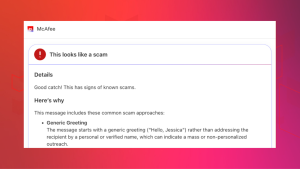
The McAfee Social Privacy Manager extends “security updates” beyond your device and into your social media footprint by scanning your privacy settings across supported platforms, flagging exposures, and recommending safer configurations. Because social platforms frequently change their settings and defaults, Social Privacy Manager also needs to stay updated to recognize and apply the right privacy protections.
15. Invest in identity theft protection.
Regardless of how careful you may be or any security systems you put in place, there is always a chance that you can be compromised in some way. It’s nice to have identity theft protection watching your back.
McAfee+ combines every day device security with identity monitoring in one suite. Depending on the plan, McAfee+ can watch for your personal info on the dark web and breach databases, monitor financial and credit activity, and send real-time alerts for anomalies. The Advanced and Ultimate plans add wider support such as credit monitoring and tracking for bank or investment accounts, as well as tools that reduce your exposure such as Personal Data Cleanup that removes your info from data broker sites. It doesn’t just warn you after a breach; it helps shrink the chances your data gets misused in the first place.
Final thoughts
Social media brings incredible opportunities, but privacy exposure, scams, and account takeovers remain real challenges that can impact your finances, reputation, and personal security. The tips outlined above give you practical ways to recognize the risks and protect your social media accounts. By raising your level of awareness and applying safe social media practices, you are building a stronger defense against evolving threats.
Make security a family affair by sharing these safe social media practices with everyone in your household—especially children and teens who use social media—so they can enjoy a safer experience.

Stay Updated
Follow us to stay updated on all things McAfee and on top of the latest consumer and mobile security threats.