

Most people don’t get scammed because they ignore warning signs.
They get scammed because they find a reason to explain those warning signs away.
The website looks a little off, but the deal is incredible. The text message is unexpected, but they’re already waiting for a package. The seller is unfamiliar, but the discount is too good to pass up.
That’s what makes major shopping events such fertile ground for scammers.
New McAfee research suggests that economic pressure may be making that problem worse, as 40% of consumers say they would trust a lower priced deal without verifying it. That means as costs are climbing, shoppers are less likely to second guess a too-good-to-be-true deal that could be a scam.
“Anyone who has ever fallen for a scam thought they would recognize one first,” McAfee’s Head of Threat Research Abhishek Karnik reminds shoppers.
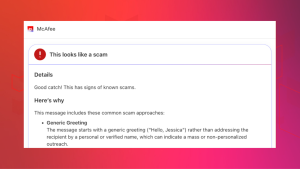
“That confidence is part of what scammers count on,” he says. “Tools like McAfee exist precisely for those moments, flagging suspicious links, messages, and offers in real time, before a split-second decision becomes a costly one.”

New McAfee Research Reveals the Cost of Deal Hunting
While most shoppers believe they can spot a scam, McAfee’s new research suggests many are engaging in behaviors that increase their risk.
Rising Prices Are Driving Riskier Shopping Decisions
Economic pressure is changing how people shop online.
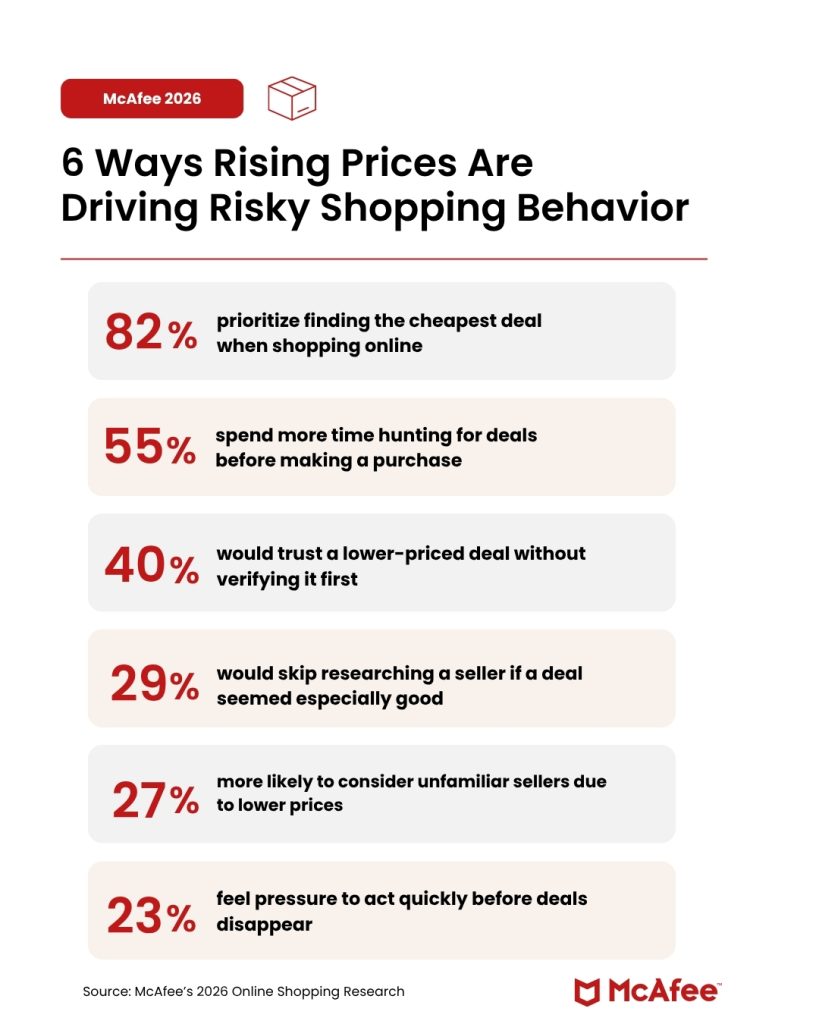
McAfee found:
- 82% prioritize finding the cheapest deal when shopping online
- 55% spend more time hunting for deals
- 40% would trust a lower-priced deal without verifying it first
- 29% would skip researching a seller if the deal seemed especially good
- 27% are more likely to consider unfamiliar sellers because of lower prices
- 23% feel pressure to act quickly before deals disappear
The same behaviors that help shoppers find bargains can also make them more vulnerable to fraud.
“What the data reflects is that economic pressure has effectively done some of the scammer’s work for them,” says Karnik. “When consumers are already primed to move quickly and prioritize price over authenticity, it takes far less effort to push them toward a bad click or a fraudulent purchase.”
Shopping Scams Are Already Costing Americans Real Money
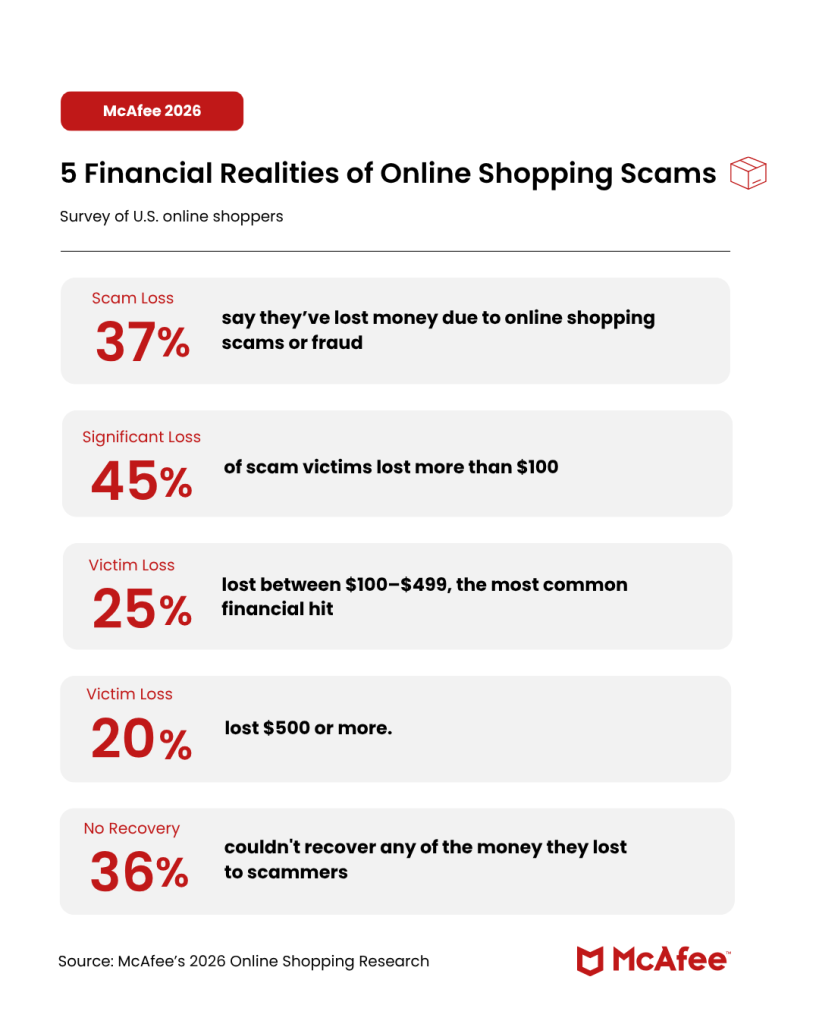
The financial impact is significant:
- 37% say they have lost money due to online shopping scams or fraud
- 45% of victims lost more than $100
- 25% lost between $100 and $499
- 20% lost $500 or more
- 36% were unable to recover any of their money
AI Is Making Shopping Scams Harder to Spot
Consumers are increasingly aware that artificial intelligence is changing the scam landscape.
According to McAfee research:
- 70% agree AI-generated content is making shopping scams harder to identify
- Nearly three-quarters have encountered shopping content they believed was suspicious or AI-generated
“The signs people have historically relied on, poor grammar, low-quality images, obviously off branding, are no longer reliable,” advises Karnik. “AI has lowered the production cost of a convincing fake to nearly zero.”
It’s not just a fake landing page fraudsters are creating.
“AI is being used to make fake review sections, impersonation messages that look exactly like it came from a major retailer, realistic logos, believable URLS,” Karnik says. “When you’re shopping online, you need to adjust your expectations to match that new AI reality.”
What Are the Most Common Shopping Scams During Major Sales Events?
Scammers follow consumer attention.
Whenever millions of people are searching for deals at the same time, scammers create fake websites, impersonate retailers and delivery companies, and use urgency to pressure shoppers into acting before they think.
Here are some of the most common shopping scams consumers encounter during major sales events, as well as the red flags consumers can watch for:
| Scam Type | How It Works | Red Flags |
| Fake shopping websites | Fraudulent websites mimic real retailers and disappear after collecting payments | Prices far below competitors, little company information, newly created websites |
| Fake social media ads | Ads promote products that never arrive or are counterfeit | Too-good-to-be-true discounts, limited reviews, unfamiliar brands |
| Delivery notification scams | Fake package alerts claim there is an issue with your shipment | Unexpected texts, suspicious links, requests for payment |
| Retailer impersonation scams | Messages claim there is a problem with your account or order | Urgent language, login requests, unfamiliar sender addresses |
| QR code scams | QR codes redirect shoppers to fraudulent websites | Codes placed on flyers, posters, packages, or public locations |
| Brushing scams | Unsolicited packages arrive at your home | Items you never ordered, requests to scan codes or leave reviews |
| Fake recall scams | Messages claim a recent purchase has been recalled | Requests for payment, account credentials, or personal information |
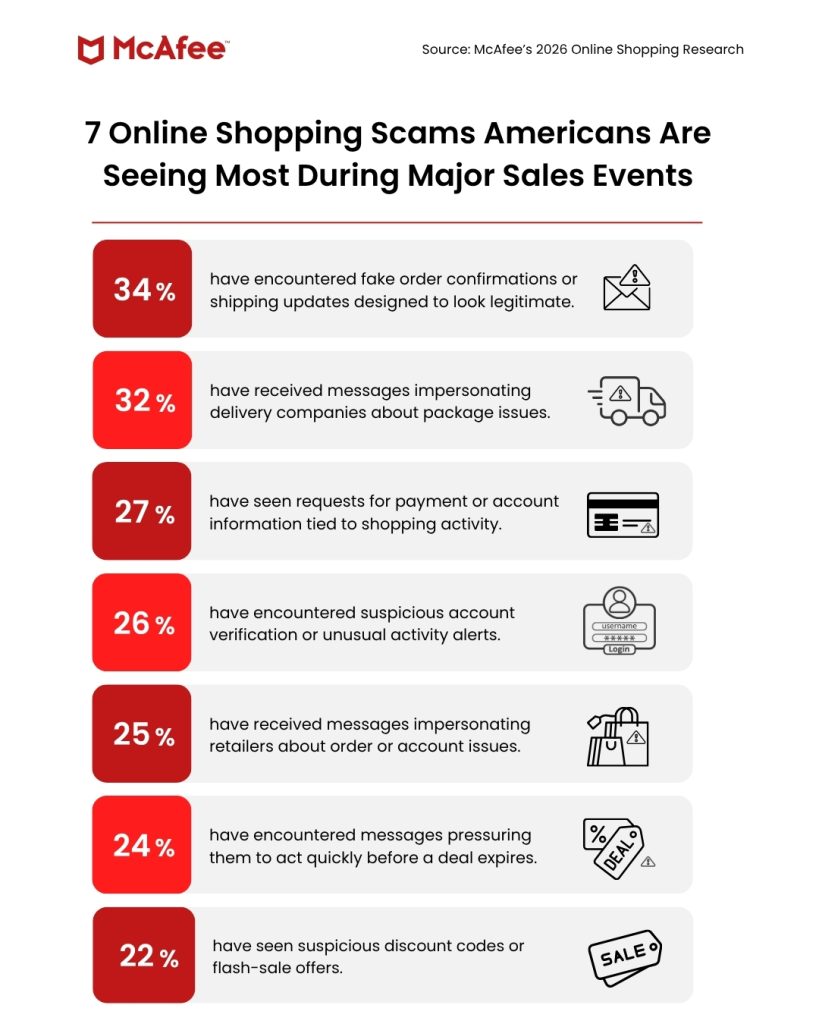
According to McAfee research, consumers most commonly report encountering fake shipping notifications, delivery scams, retailer impersonation scams, account alerts, and suspicious discount offers during major shopping periods.
How McAfee Can Help
With McAfee+ Premium, multiple layers work together before any damage is done:
- Scam Detector flags suspicious texts, emails, links, QR codes, and even deepfake videos before you engage
- Secure VPN keeps your data private, especially on public Wi-Fi
- Web Protection helps block risky sites, even if you do accidentally click helps block risky sites, even if you do accidentally click
- Password Manager doesn’t just help you make unique, strong passwords, it keeps them stored and organized for you
- Device Security helps detect malicious apps or downloads
- Identity Monitoring alerts you if your personal info shows up where it should not, so you can act fast
- Personal Data Cleanup helps remove your information from sites selling it.
- Online Account Cleanup assists in taking down your old, forgotten accounts across the web
- Social Privacy Manager helps you monitor and change privacy settings across your social platforms in just a few clicks
Together, these protections are designed to address the broader range of online risks people face every day.
Plus, click here to get McAfee’s limited-time deals on real-time protection this Amazon Prime Day, from June 23 to June 26.
About our consumer research
McAfee surveyed 1,000 U.S. adults in May 2026 as part of a broader study of 5,000 respondents across the U.S., UK, France, Germany, and Japan, focused on online shopping intentions, scam awareness, and purchase behaviors.
Stay Updated
Follow us to stay updated on all things McAfee and on top of the latest consumer and mobile security threats.